
Scanner Architecture
Understand the detection engine internals and where its weaknesses lie.
Overview
The AMSI Raccoon Lab scanner is built in Nim and operates in two modes:
| Component | File | Purpose |
|---|---|---|
| Standalone Scanner | nim_antimalware_sim.nim |
Command-line file scanner (EXE) |
| AMSI Provider | nim_amsi_wrapper_dll.nim |
Windows AMSI integration (DLL) |
Both share the same detection engine with 6 sequential checks.
Detection Pipeline
Every scanned file passes through these 6 checks in order:
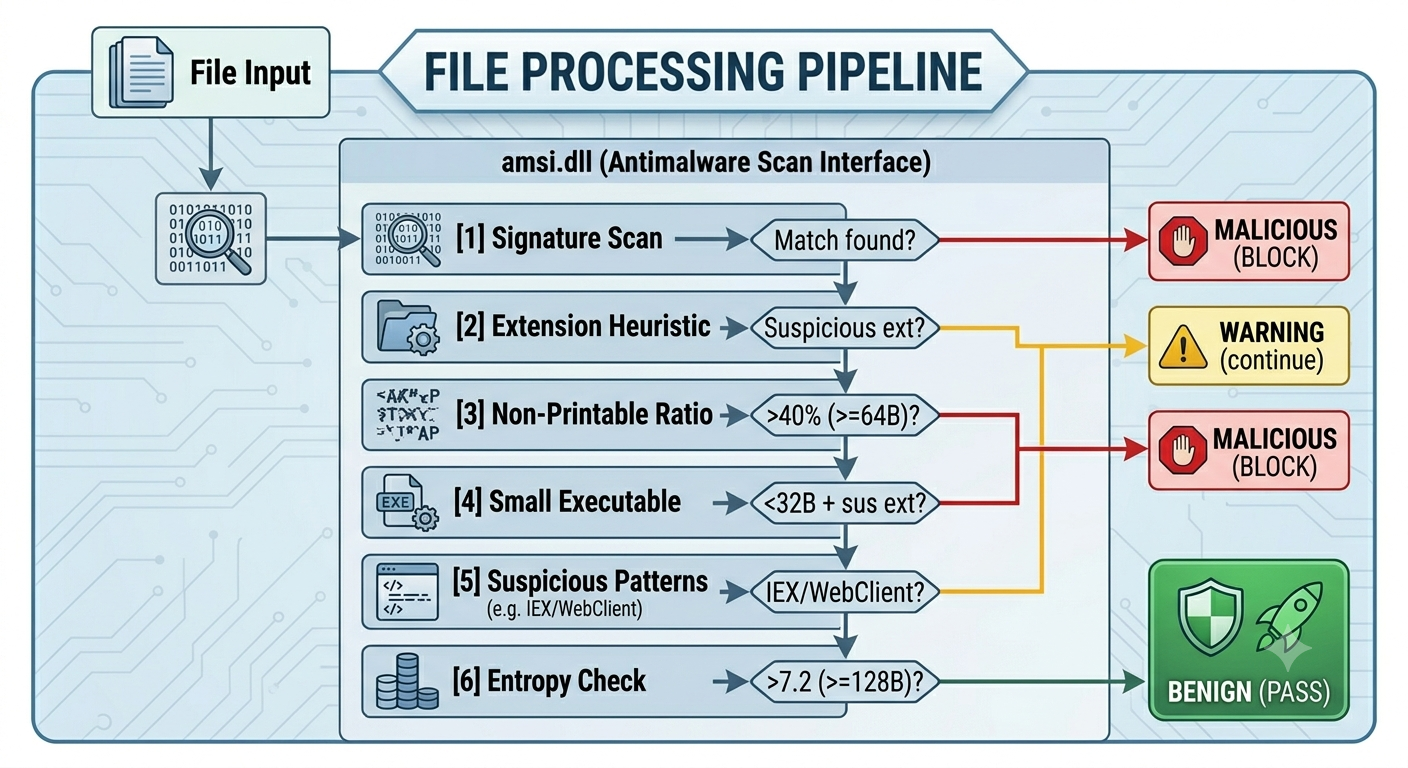
Check 1: Signature Detection
Action: BLOCKS
Weakness: Only 7 static strings, no deobfuscation
const signatures = [
  "malware", "virus", "trojan", "evil_payload",
  "dropper", "ransomware", "payload.exe"
]
How it works:
- Read entire file content as raw bytes
- Convert to lowercase ASCII (only 0x41–0x5A range is lowered)
- Search for each signature as a contiguous substring
- If ANY match found: file is MALICIOUS
Exploitable weaknesses:
- No regex/YARA pattern matching
- Only exact contiguous matches
- No Unicode normalisation
- No decoding (Base64, XOR, etc.)
- Only 7 signatures in the database
Check 2: Extension Heuristic
Action: WARNING only (never blocks)
Weakness: Does not enforce blocking, limited list
const suspiciousExtensions = [
  ".exe", ".dll", ".bat", ".cmd", ".sh",
  ".ps1", ".scr", ".js", ".vbs", ".jar", ".lnk"
]
How it works:
- Extract extension via
rfind('.')on the filename - Take everything after the last dot
- Lowercase comparison against the list
- If match: emit warning, continue scanning (does not block)
Exploitable weaknesses:
- Uses
rfind('.')(ASCII only, not Unicode-aware) - Warning-only design (
discard engine.extensionHeuristic()) - Only 11 extensions in the list
- No magic byte validation
- No content-based type detection
Check 3: Non-Printable Byte Ratio
Action: BLOCKS
Weakness: Minimum size gate, global ratio, no decoding
# Only runs if file size >= 64 bytes
let ratio = non_printable_count / total_bytes
if ratio > 0.40:
  result = MALICIOUS
How it works:
- Skip if file size < 64 bytes
- Count bytes outside the printable range:
b < 9,14 ≤ b < 32, orb > 126 - Calculate ratio: non-printable / total
- If ratio > 0.40 (40%): file is MALICIOUS
Exploitable weaknesses:
- 64-byte minimum size (small files bypass)
- Global ratio (padding dilutes it)
- No Base64 detection/decoding
- No per-section analysis
- No archive unpacking (but ZIP files themselves typically exceed 40% — see Challenge #19)
Check 4: Small Executable Detection
Action: BLOCKS
Weakness: Dual condition easily broken
if file_size < 32 and isSuspiciousExtension(ext):
  result = MALICIOUS
How it works:
- Check if file size < 32 bytes
- Check if extension is in the suspicious list
- If BOTH conditions met: file is MALICIOUS
Exploitable weaknesses:
- Requires both conditions (break either one)
- Same limited extension list as Check 2
- Comments/padding easily push past 32 bytes
Check 5: Suspicious Pattern Detection
Action: WARNING only (never blocks)
Weakness: Critical design flaw — detects but discards the result
# Full pattern list from nim_antimalware_sim.nim (22 entries):
const suspiciousPatterns = [
  "invoke-expression",   "iex(",              "iex ",
  "downloadstring",      "downloadfile",      "webclient",
  "bitstransfer",        "start-process",     "invoke-webrequest",
  "net.webclient",       "reflection.assembly", "frombase64string",
  "encodedcommand",      "bypass",            "hidden",
  "-nop",                "-noni",             "amsiutils",
  "amsiinitfailed",      "virtualallocex",    "writeprocessmemory",
  "createremotethread",  "shellcode"
]
How it works:
- Search for any of the 22 patterns (case-insensitive via ASCII lowercase)
suspiciousPatternCheckreturnsfalsewhen a pattern is found- The pipeline calls it with
discard— the return value is thrown away - Scanning continues regardless of the result
# The bug is at the call site, not inside the proc:
discard engine.suspiciousPatternCheck()  # Warning only, doesn't block
Exploitable weaknesses:
discardat the call site means detection has zero effect- All 22 patterns — including download cradles and AMSI internals — pass as BENIGN
- No behavioural analysis of detected patterns
Check 6: Entropy Analysis
Action: WARNING only (never blocks)
Weakness: Advisory only, high threshold
# Only runs if file size >= 128 bytes
let entropy = shannonEntropy(content)
if entropy > 7.2:
  # Warning: possibly encrypted/compressed
How it works:
- Skip if file size < 128 bytes
- Calculate Shannon entropy (bits per byte, max 8.0)
- If entropy > 7.2: emit warning (does not block)
Exploitable weaknesses:
- Warning only (
discard engine.entropyCheck()) - 128-byte minimum size
- Does not identify encryption algorithm
- No attempt to decrypt or decompress
AMSI Provider Architecture
For a comprehensive explanation of AMSI, how it works, and why it’s bypassable, see AMSI Explained.
When registered as an AMSI provider, the DLL integrates with Windows:
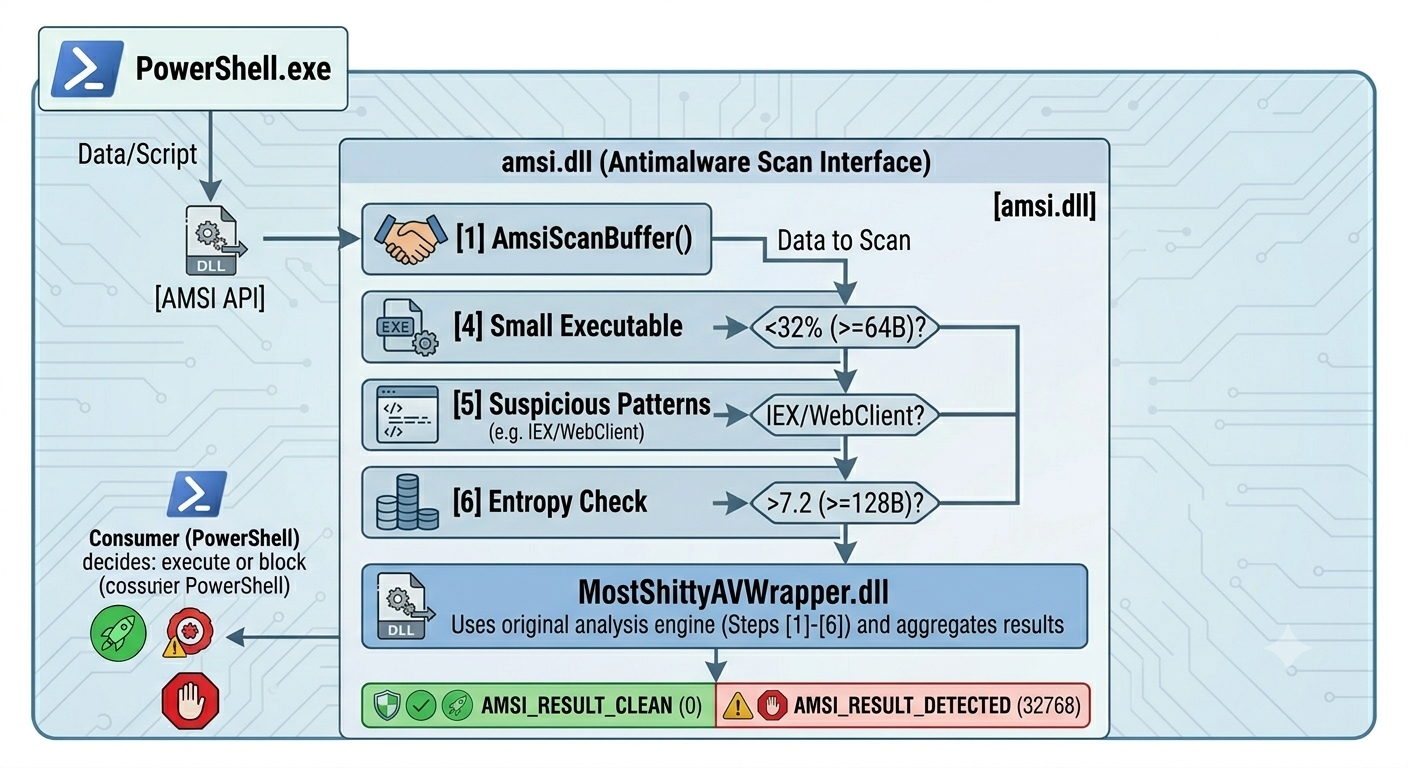
Key points:
- Runs in the calling process’s address space (user-mode)
- Process has full control over its own memory
- COM-based registration (HKLM registry)
ScanImplreads scan content viaIAmsiStream::GetAttribute(CONTENT_ADDRESS + CONTENT_SIZE)- Can be hijacked via HKCU COM override (see Challenge #35)
Known Design Weaknesses Summary
| # | Weakness | Impact | Category |
|---|---|---|---|
| 1 | Extension check doesn’t block | High | Design flaw |
| 2 | Suspicious pattern check doesn’t block | High | Design flaw |
| 3 | Entropy check doesn’t block | Medium | Design flaw |
| 4 | Only 7 signature strings | High | Coverage gap |
| 5 | No deobfuscation engine | High | Evasion gap |
| 6 | No Unicode normalisation | High | Encoding gap |
| 7 | No archive/container scanning | Medium | Coverage gap |
| 8 | No PE/ELF structural analysis | High | Analysis gap |
| 9 | Global ratio instead of per-section | Medium | Precision gap |
| 10 | 64-byte minimum for ratio check | Medium | Threshold gap |
| 11 | No behavioural analysis/sandboxing | High | Architecture gap |
| 12 | User-space AMSI (memory accessible) | High | Platform limitation |
Project Structure
MostShittyAV/
├── src/
│   ├── nim_antimalware_sim.nim        # Main scanner engine
│   ├── nim_amsi_wrapper_dll.nim       # AMSI provider DLL
│   ├── MostShittyAVWrapper.dll        # Compiled DLL
│   └── nim_antimalware_sim.exe        # Compiled EXE
├── tests/
│   ├── 01_clean/                      # Baseline benign files
│   ├── 02_signature/                  # Signature + bypass tests
│   ├── 03_encoding/                   # Ratio + bypass tests
│   ├── 04_extension/                  # Extension + bypass tests
│   ├── 05_small_executable/           # Small exe tests
│   ├── 06_amsi_bypass/                # AMSI bypass techniques
│   └── scripts/                       # Test generation
├── challenges/                        # Challenge descriptions
├── solutions/                         # Solution walkthroughs
├── scripts/                           # Build & registration
├── docs/                              # Additional documentation
└── static/                            # Logo and assets
Further Reading
- AMSI_EXPLAINED.md - What AMSI is and how it works
- BYPASS_TECHNIQUES.md - Full bypass reference
- USAGE_COMPARISON.md - DLL vs EXE comparison
- TEST_REGISTERED_PROVIDER.md - Testing with Process Monitor