
 Attack Trees are a structured, methodical way to describe the security of a system based on varying attacks. They represent attacks against a system in a tree structure, with the attacker’s goal as the root and the different ways to achieve that goal as branches and leaves.
While a Threat Model casts a wide net from the top — asking “what can go wrong across the system?” — an Attack Tree starts from one specific adversarial goal and decomposes it downward into the concrete steps required to achieve it. Both perspectives are essential: top-down breadth meets bottom-up depth.
Why Attack Trees?
Traditional threat modeling (STRIDE, data flow diagrams, trust boundaries) excels at providing a broad, top-down overview of a system’s security posture. But it can remain abstract. Attack Trees complement this by:
- Forcing you to think like an attacker — “How would I actually achieve this goal?”
- Decomposing complex attacks into concrete, actionable steps
- Revealing single points of failure and critical attack paths
- Enabling quantitative risk assessment — assign cost, difficulty, or probability to each node
- Providing a shared language between red teams, blue teams, and engineering
How Attack Trees Work
An attack tree is a hierarchical diagram built from top to bottom:
Core Concepts
Root Node — The attacker’s ultimate goal (e.g., “Exfiltrate customer PII”, “Gain admin access”, “Disrupt payment processing”)
Intermediate Nodes — Sub-goals or stages that contribute to achieving the root goal
Leaf Nodes — The actual, atomic attack vectors an attacker would execute (e.g., “Exploit SQL injection in /api/search”, “Phish employee for VPN credentials”)
Gates (Logical Operators):
| Gate | Meaning | Example |
|---|---|---|
| OR | Any one child is sufficient to achieve the parent | Attacker can steal credentials via phishing OR credential stuffing OR session hijacking |
| AND | All children must succeed together | Attacker must bypass MFA AND have valid password AND evade detection |
Node Attributes — Each leaf node can be annotated with:
- Complexity — How difficult is this step? (Low / Medium / High)
- Cost — How expensive for the attacker?
- Detectability — How likely are defenders to notice?
- Required capabilities — What threat actor profile is needed?
- Existing controls — What security measures already mitigate this?
A Practical Example: Account Takeover
From this tree, defenders can immediately see:
- There are 7 distinct attack vectors (leaf nodes) to defend against
- The social engineering path requires BOTH steps (AND gate) — breaking either one blocks the path
- Credential theft has three independent options (OR gate) — all three must be mitigated
- XSS leading to session hijacking might be the cheapest attack for the adversary
Top-Down vs. Bottom-Up: Complementary Directions
Understanding why both perspectives matter is crucial to building robust security:
| Threat Modeling (Top-Down) | Attack Trees (Bottom-Up) | |
|---|---|---|
| Starting point | The system architecture and data flows | A specific attacker goal |
| Question asked | “What can go wrong across this system?” | “How exactly would an attacker achieve this goal?” |
| Breadth vs. depth | Broad coverage, may stay abstract | Deep analysis of specific scenarios |
| Output | Categorized threats (STRIDE), trust boundaries, risk priorities | Concrete attack paths, required steps, control gaps |
| Blind spot | Can miss detailed, multi-step attack chains | Can miss systemic issues outside the chosen goal |
| Best for | Initial security assessment, architecture review, compliance | Validating controls, red team planning, incident preparation |
Stronger Together
The real power comes from combining both:
Example workflow:
- A STRIDE-based threat model identifies “Elevation of Privilege via API” as a high-risk threat
- An attack tree decomposes this goal into concrete paths: IDOR, JWT manipulation, role parameter tampering, privilege escalation via dependency vulnerability
- Security controls are mapped to each leaf node — revealing that JWT manipulation has no mitigation
- A targeted security test (micro attack simulation) validates whether the gap is exploitable
- The finding feeds back into the backlog and the threat model is updated
The Purple Team Mindset
Attack trees are uniquely powerful because they serve both sides of the security equation. They are a natural collaboration artifact for purple teaming — where offensive and defensive perspectives merge.
The Attacker’s View (Red Team)
When building an attack tree from an offensive perspective, you ask:
- “What is my goal?” (Root node)
- “What are all the ways I could achieve this?”
- “Which path is cheapest/easiest/least detectable?”
- “Where are the gaps in their defenses?”
The red team uses attack trees to:
- Plan engagements — Identify the most promising attack paths before testing
- Prioritize efforts — Focus on paths with high impact and low complexity
- Document findings — Show exactly how an attack chain was executed
- Discover alternative paths — If one path is blocked, what else is possible?
The Defender’s View (Blue Team)
When reviewing an attack tree from a defensive perspective, you ask:
- “Which leaf nodes do we already have controls for?”
- “Where are the AND gates?” (Breaking one child blocks the entire path)
- “Where are the OR gates?” (ALL children must be mitigated)
- “What is the cheapest way to eliminate the most paths?”
The blue team uses attack trees to:
- Prioritize control implementation — Focus on controls that block the most paths (closest to root)
- Identify single points of failure — Nodes where one missing control opens an entire attack path
- Validate detection coverage — Are there leaf nodes we can’t even detect?
- Justify security investment — “This one control blocks 4 out of 7 attack paths”
The Purple Sweet Spot
When red and blue build attack trees together, something powerful happens:
- Attackers challenge defenders — “You have WAF, but does it catch this specific payload variation?”
- Defenders inform attackers — “We have compensating controls here you might not see externally”
- Both discover unknowns — “Neither of us considered this path — let’s test it”
- Controls get validated — Not just theoretically present, but actually effective against the modeled attack
An attack tree is a living document. Every penetration test result, every incident, every new feature should potentially update it. The tree grows as your understanding of the threat landscape deepens.
Mapping Security Controls in Attack Trees
A critical step is overlaying your existing security controls onto the tree:
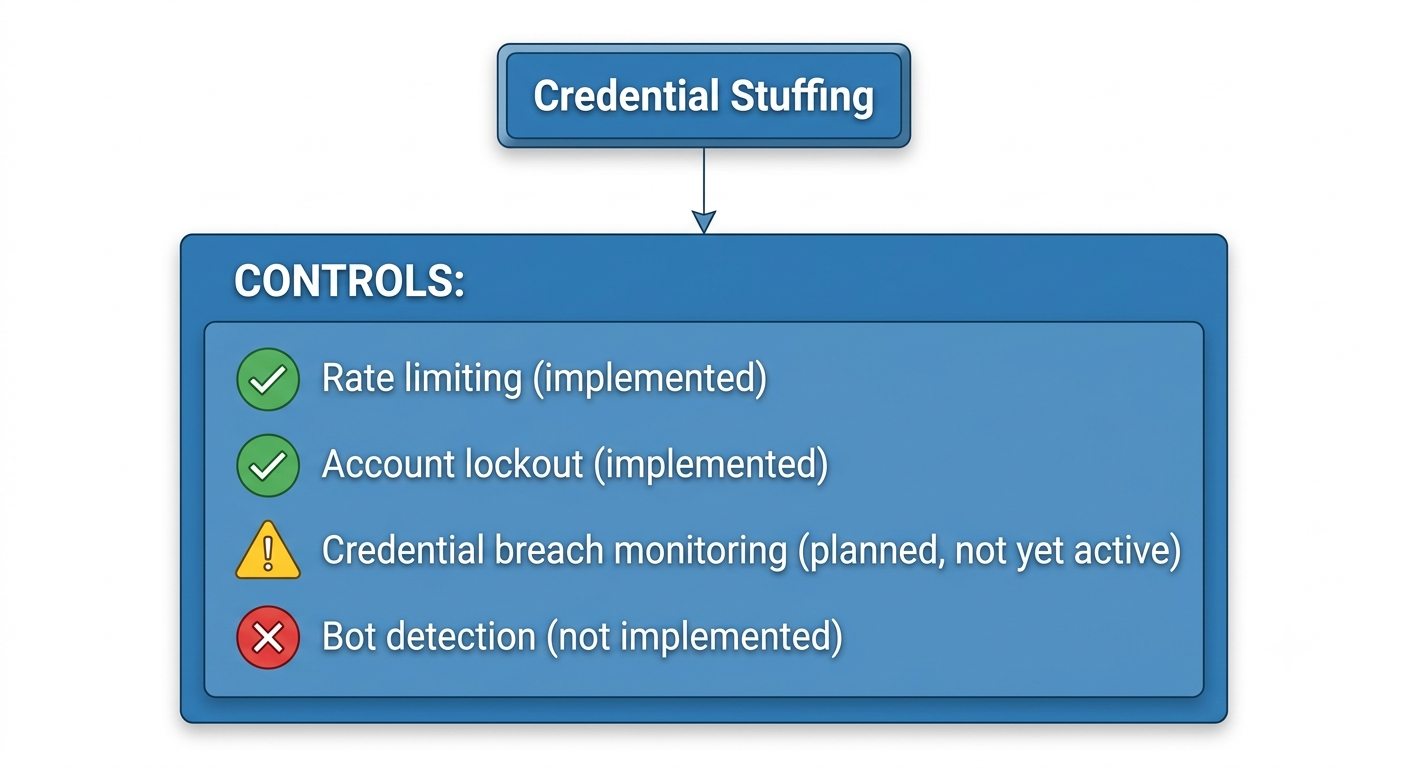
This visualization makes it immediately clear:
- What is protected (and how effectively)
- What has gaps
- What the implementation status of planned controls is
- Where to invest next
Tooling: attacktree.online
attacktree.online by Christian Schneider is a free SaaS platform for building and analyzing attack trees. It provides a structured workflow that covers the full lifecycle:
Key Features
1. Threat Actor Modeling
- Define threat actors with specific capabilities and motivations
- Tailor the tree to realistic adversary profiles (script kiddie vs. nation-state)
2. Impact Definition
- For each attack goal, define the business impact
- Maps to stakeholders: customers, business operations, reputation
3. Tree Construction
- Visual tree builder with AND/OR gates
- Assign actors and complexity levels to leaf nodes
- Built-in suggestion library with MITRE CAPEC and CWE mappings
- Optional AI suggestions for additional attack vectors
4. Security Control Management
- Add preventive, detective, and compensating controls
- Position controls strategically (closer to root = broader protection)
- Define effectiveness and cost for prioritization
- Track implementation status per control
- Validation steps for audit confirmation
5. Risk Simulation
- Monte Carlo simulation to identify critical paths
- What-if analysis for roadmap planning
- Identify “Achilles’ heels” — single points where a missing control opens multiple paths
- Generate prioritized implementation roadmaps
6. Reporting & Integration
- Interactive dashboards
- PDF reports and Excel exports (control-to-attack mappings)
- SVG export for documentation
- API for integration into existing toolchains
Micro Attack Simulations
A particularly powerful concept enabled by attack trees: rather than running full-blown red team engagements, use the tree to run targeted micro simulations — testing specific leaf nodes or paths to validate whether controls actually work as expected. This is:
- Cheaper than a full penetration test
- More focused and actionable
- Repeatable as part of continuous validation
- Aligned with specific risk scenarios rather than broad scope
Building an Attack Tree: Step by Step
-
Define the goal — What does the attacker want? Be specific. “Exfiltrate customer payment data” is better than “hack the system.”
-
Brainstorm attack paths — What are the fundamentally different approaches? (Network attack, social engineering, insider threat, supply chain, physical access…)
-
Decompose into steps — For each path, what intermediate steps are needed? Keep going until you reach atomic, testable attack vectors.
-
Assign gate logic — Is this an OR (any path works) or AND (all steps required)? AND gates are your friend as a defender.
-
Annotate leaf nodes — Add complexity, required capabilities, and cost. This helps prioritize.
-
Map existing controls — For each leaf node, what controls exist? What is their status and effectiveness?
-
Analyze and prioritize — Where are the cheapest, easiest, least-detected paths? Those need attention first.
-
Validate — Use the tree to derive targeted tests (micro attack simulations) that confirm controls work.
-
Iterate — Update the tree after incidents, pen tests, architecture changes, or new threat intelligence.
When to Use Attack Trees
Attack trees are particularly valuable when:
- A threat model has identified a high-priority threat that needs deeper analysis
- Planning a penetration test or red team engagement (scope and focus)
- Justifying security investment to stakeholders (“this control blocks these 5 attack paths”)
- After an incident — modeling how the attack worked and what alternative paths existed
- Evaluating a new feature’s security posture before launch
- During purple team exercises to structure collaboration
- Assessing third-party/supply chain risk
Additional Sources and References
- Bruce Schneier - Attack Trees (1999) — The original paper that introduced attack trees to the security community
- attacktree.online — Free SaaS platform for attack tree modeling with risk simulation
- Christian Schneider - Attack Tree Consulting — Background on the methodology and tooling
- Micro Attack Simulations (BruCON/DeepSec 2023) — Using attack trees for targeted validation
- MITRE CAPEC — Common Attack Pattern Enumeration and Classification (useful for populating leaf nodes)
- Threat Modeling: Designing for Security (Adam Shostack) — Chapter on attack trees in the context of broader threat modeling
- OWASP Attack Tree Cheat Sheet — Practical guidance for building attack trees