
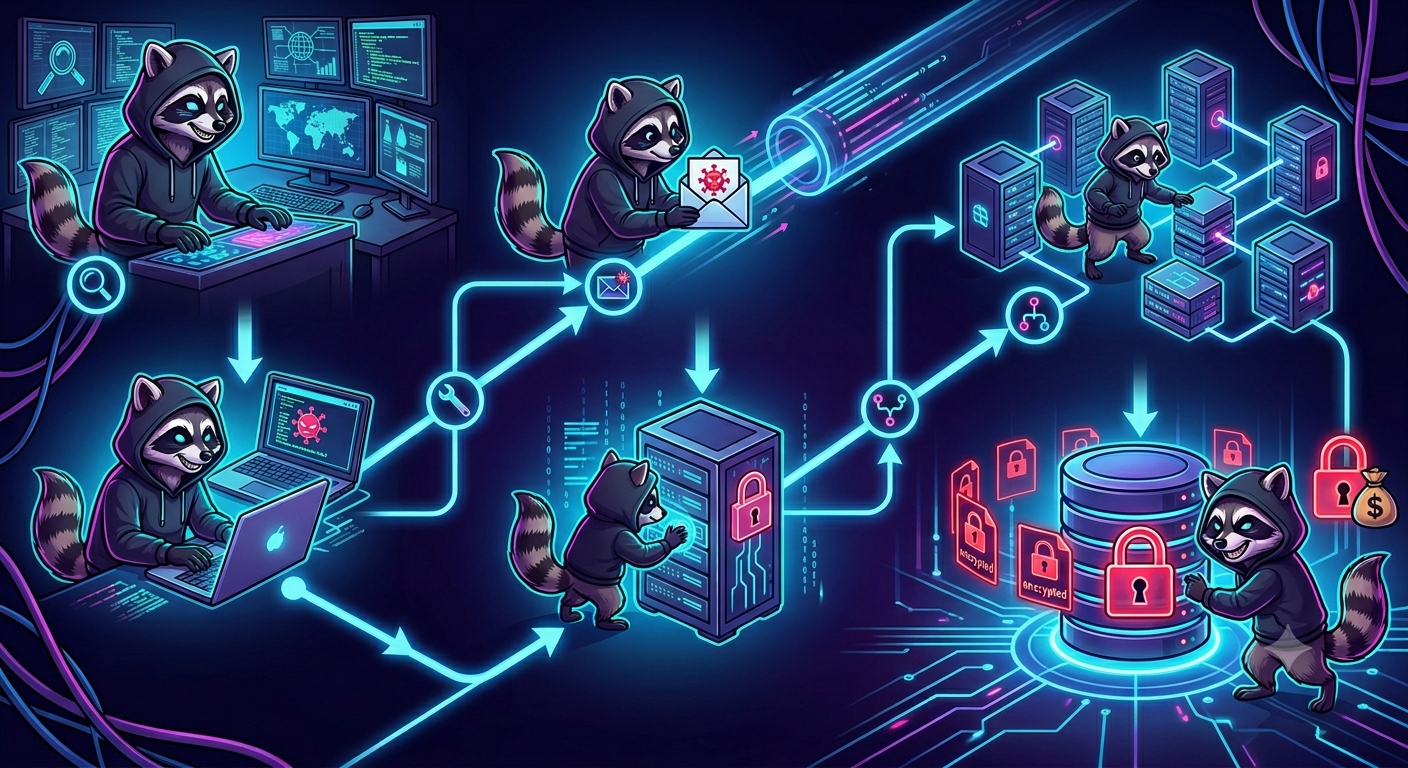
 Ransomware is no longer a smash-and-grab operation. Modern ransomware groups operate as full businesses — with HR, affiliate programmes, SLAs, and PR teams. Understanding their kill chain is the prerequisite for stopping them at any stage. This article maps the unified end-to-end ransomware attack lifecycle, ties each phase to MITRE ATT&CK tactics, and connects them to the MITRE impact categories defenders must use when writing incident impact statements.
| Related: Threat Modeling | Attack Trees | Security Maturity Models |
- Why a “Unified” Kill Chain?
- Kill Chain at a Glance
- The Eight Phases
- MITRE Attack Effect Categories
- Writing Impact Statements
- Detection Signals per Phase
- Defense-in-Depth Mapping
- IR Recovery Considerations
Why a “Unified” Kill Chain?
Lockheed Martin’s original Cyber Kill Chain was designed for nation-state intrusions. MITRE ATT&CK extended it into a detailed tactics-and-techniques matrix. Neither was purpose-built for ransomware — which adds phases the original model never anticipated: pre-encryption data staging, backup destruction, and negotiation leverage.
The Unified Ransomware Kill Chain stitches these together:
| Source model | Contribution |
|---|---|
| Lockheed Kill Chain | Linear phase structure: recon → weaponize → deliver → exploit → install → C2 → act |
| MITRE ATT&CK | Granular techniques and sub-techniques mapped to each phase |
| Ransomware-specific research | Double/triple extortion, backup destruction, affiliate TTPs |
| Blue Team Handbook (MITRE) | Impact categorization framework for incident response statements |
The result is a model defenders can use both offensively (to simulate attacks in purple-team exercises) and defensively (to map controls, generate detection rules, and write accurate impact statements for leadership).
Kill Chain at a Glance
Access
PrivEsc
Evasion
& Discovery
Movement
(double ×)
The Eight Phases
Phase 1 — Initial Access
Goal: Get a foothold inside the target network.
Ransomware operators — whether direct threat actors or RaaS affiliates — almost always enter through one of four vectors:
| Vector | Examples | Prevalence |
|---|---|---|
| Phishing / spear-phishing | Macro-enabled Office docs, HTML smuggling, QR-code lures | Highest |
| Exposed remote services | RDP on port 3389, VPN appliances (Citrix, Pulse, Fortinet), Exchange | High |
| Valid credentials (purchased) | Initial Access Brokers sell stolen VPN/RDP creds on darknet markets | Growing |
| Supply chain / trusted software | Trojanised updates, compromised MSP tools (Kaseya, ConnectWise) | Targeted |
| Drive-by / watering hole | Malvertising chains, exploit kits against unpatched browsers | Low but persistent |
MITRE ATT&CK: T1566 (Phishing), T1133 (External Remote Services), T1078 (Valid Accounts), T1195 (Supply Chain Compromise)
Defender note: The single most impactful control at this phase is MFA on every internet-facing service. RDP and VPN accounts without MFA are the number-one ransomware entry point year after year.
Phase 2 — Execution
Goal: Run the initial payload on the victim machine.
Modern ransomware loaders avoid dropping executable files where possible. They prefer to live entirely in memory or abuse signed Windows binaries:
- PowerShell / WMI —
IEX(New-Object Net.WebClient).DownloadString(...)executes in-memory stagers - LOLBins (Living off the Land) —
mshta.exe,regsvr32.exe,certutil.exe,wscript.exeall execute attacker-controlled payloads while appearing as legitimate Windows processes - Malicious macros — Still effective; Office macro execution is blocked by default in current Microsoft 365 policies but legacy environments lag behind
- DLL sideloading — Drop a malicious DLL next to a legitimate signed executable; the OS loads it automatically
MITRE ATT&CK: T1059 (Command and Scripting Interpreter), T1218 (System Binary Proxy Execution), T1055 (Process Injection)
Phase 3 — Persistence & Privilege Escalation
Goal: Survive reboots and reach SYSTEM or Domain Admin.
Ransomware operators do not immediately encrypt. They dwell — often for days to weeks — establishing persistence and escalating privileges before detonating. This dwell time is the defender’s window.
Persistence mechanisms:
- Registry run keys (
HKCU\Software\Microsoft\Windows\CurrentVersion\Run) - Scheduled tasks with system-level triggers
- Windows services (install a new service or hijack a vulnerable one)
- WMI subscriptions (survive across reboots silently)
- Boot/pre-OS persistence (bootkits — rare, used by Fancy Bear and some RaaS groups)
Privilege escalation paths:
- Unpatched local privilege escalation — PrintNightmare, EternalBlue, LocalPotato
- Token impersonation — Steal tokens from higher-privileged processes using
SeImpersonatePrivilege - Kerberoasting — Request TGS tickets for service accounts with SPNs, crack offline
- AS-REP Roasting — Accounts without pre-auth enabled; no credentials needed to get a crackable hash
- Pass-the-Hash / Pass-the-Ticket — Harvest NTLM hashes or Kerberos TGTs and reuse
MITRE ATT&CK: T1053 (Scheduled Task), T1543 (Create/Modify System Process), T1558 (Steal/Forge Kerberos Tickets), T1134 (Access Token Manipulation)
Phase 4 — Defense Evasion
Goal: Blind or bypass the defender’s visibility tools before the noisy phases begin.
This is where sophisticated ransomware groups separate themselves from commodity ransomware:
| Technique | What it does |
|---|---|
| AMSI bypass | Patches AmsiScanBuffer in memory; PowerShell scripts become invisible to antivirus |
| ETW patching | Disables Windows Event Tracing; EDRs that depend on ETW go blind |
| Timestomping | Modifies file $STANDARD_INFORMATION timestamps to hide new files |
| Log clearing | wevtutil cl Security, wevtutil cl System — erases Windows event logs |
| EDR tampering | Kills EDR agent processes or drivers via vulnerable signed drivers (BYOVD — Bring Your Own Vulnerable Driver) |
| Process injection | Injects malicious code into legitimate processes (svchost, explorer) to evade process-based whitelisting |
| Signed binary abuse | Code-signed malware or abusing Microsoft-signed binaries |
MITRE ATT&CK: T1562 (Impair Defenses), T1070 (Indicator Removal), T1055 (Process Injection), T1553 (Subvert Trust Controls)
BYOVD alert: Groups like BlackCat/ALPHV and Clop have used vulnerable drivers from legitimate vendors (Gigabyte, Dell) to terminate EDR processes with kernel-level privileges. Monitor for new kernel driver loads (
Sysmon Event ID 6) from unusual paths.
Phase 5 — Credential Access & Discovery
Goal: Harvest every credential available; map the entire network.
With elevated privileges, operators dump credentials aggressively:
Credential harvesting:
lsass.exememory dump via Task Manager,procdump,comsvcs.dll, or direct syscall (NanoDump,SilentProcessExit)- SAM database extraction (
reg save HKLM\SAM) NTDS.ditextraction from Domain Controllers (the keys to the kingdom — contains every AD password hash)- Browser credential stores (Chrome’s
Login DataSQLite database, credential manager) - SSH keys, API tokens, cloud credentials from developer workstations
Network discovery:
nltest /dclist— enumerate Domain Controllersnet group "Domain Admins"— list privileged accountsAdFind.exe,BloodHound/SharpHound— graph Active Directory attack pathsnmap,masscan,Advanced IP Scanner— map reachable hosts and open ports- SMB share enumeration to identify file servers holding valuable data
MITRE ATT&CK: T1003 (OS Credential Dumping), T1018 (Remote System Discovery), T1087 (Account Discovery), T1482 (Domain Trust Discovery)
Phase 6 — Lateral Movement
Goal: Spread across the network to high-value targets (domain controllers, file servers, backup infrastructure, ESXi hypervisors).
| Technique | Tool / method | Why ransomware operators prefer it |
|---|---|---|
| Pass-the-Hash | Mimikatz, Impacket |
No plaintext password needed — reuse NTLM hash |
| PsExec / SMBExec | PsExec.exe, Impacket psexec.py |
Runs commands remotely over SMB using admin shares |
| WMI / WinRM | wmic.exe /node:, PowerShell remoting |
Built-in, usually not blocked internally |
| RDP hijacking | Hijack existing disconnected sessions | Interactive sessions with no new logon event |
| GPO abuse | Modify Group Policy Objects to push malware to all domain members | One action infects thousands of machines |
| Golden / Silver Tickets | Mimikatz kerberos::golden |
Forge Kerberos tickets after NTDS.dit compromise; valid for 10 years by default |
The ESXi pivot: Modern ransomware families (Black Basta, ESXiArgs, Royal) specifically target VMware ESXi hypervisors. A single encrypted hypervisor can take down hundreds of virtual machines simultaneously — maximising impact while minimising the number of hosts that need to be reached.
MITRE ATT&CK: T1550 (Use Alternate Authentication Material), T1021 (Remote Services), T1484 (Domain Policy Modification)
Phase 7 — Exfiltration (Double Extortion)
Goal: Steal a copy of sensitive data before encrypting it, creating a second extortion lever.
Double extortion became the standard ransomware model around 2020 (pioneered by Maze). Triple extortion adds a third lever: DDoS attacks against the victim or direct contact with their customers.
Exfiltration methods:
- Rclone — The tool of choice; syncs local directories to attacker-controlled cloud storage (MEGA, Backblaze, S3-compatible). Frequently seen with obfuscated config files.
- Custom upload tools — FTP/SFTP/HTTPS to attacker infrastructure
- Staging in cloud services — OneDrive, SharePoint abuse; data blend into legitimate traffic
- Slow-and-slow exfiltration — Throttled uploads to avoid bandwidth anomaly detection
What gets stolen:
- Legal documents, M&A agreements
- Employee PII, health records, payroll data
- Customer databases
- Intellectual property, source code
- Credentials and access data for further leverage
MITRE ATT&CK: T1048 (Exfiltration Over Alternative Protocol), T1567 (Exfiltration Over Web Service), T1020 (Automated Exfiltration)
Detection window: Rclone activity is highly detectable. Look for
rclone.exeor renamed variants (svchost32.exe,OneDriveSetup.exe), unusual outbound data volumes to cloud storage endpoints, and the presence ofrclone.conffiles in%APPDATA%or%TEMP%.
Phase 8 — Impact
Goal: Maximise pressure on the victim to pay.
This is the final, irreversible phase. Operators have already achieved their primary objectives — persistent access, credential harvest, data exfiltration. Encryption is the trigger that forces the victim to engage.
Pre-encryption preparation:
- Delete Volume Shadow Copies:
vssadmin delete shadows /all /quiet— removes Windows’ built-in snapshot backups - Disable Windows Recovery:
bcdedit /set {default} recoveryenabled No - Stop backup processes: kill agents from Veeam, Backup Exec, Acronis, SQL Server backup jobs
- Wipe network-accessible backup repositories (NAS, tape libraries reached via SMB)
Encryption execution:
- Target specific file extensions (documents, databases, images) while skipping system files to keep the OS bootable
- Use hybrid encryption: generate a per-file AES-256 key, encrypt it with the attacker’s RSA public key — fast bulk encryption, no key stored on victim system
- Rename files:
.locked,.BlackCat,.conti, etc. - Drop ransom note in every directory:
README.txt,DECRYPT_MY_FILES.html
MITRE ATT&CK: T1490 (Inhibit System Recovery), T1489 (Service Stop), T1486 (Data Encrypted for Impact), T1491 (Defacement)
MITRE Attack Effect Categories
When documenting a ransomware incident for leadership, legal, or insurance, defenders must translate technical findings into business impact language. The MITRE framework (sourced from Blue Team Handbook: Incident Response Edition, referencing MITRE Scott Mussman et al. Jul 2010 and NIST SP 800-115) defines six impact categories:
| Category | Definition | Ransomware manifestation |
|---|---|---|
| Degradation | Performance impact that can be measured before or after the event | Encryption process consumes 100% CPU/disk I/O; systems become unusable before full encryption completes |
| Interruption | Asset or system unavailable for a time period | Encrypted servers, locked workstations, downed ESXi hypervisors — business operations halt |
| Modification | Data, filesystem, software, or packets altered either at rest or in transit | Every encrypted file is a modification; ransomware also modifies the MBR (some variants), registry, and scheduled tasks |
| Fabrication | New or suspect information introduced into a system | Ransom notes deposited in every directory; rogue user accounts created; fake scheduled tasks and services installed |
| Unauthorized Use | Resources used for attacker’s own purposes, or inappropriately used by a person in a position of trust | Victim compute and storage used for crypto-mining during dwell time; exfiltrated data used to harm third parties |
| Interception | Information leaked and used by an attacker | Double extortion: stolen customer PII, financial records, and IP published on leak sites if ransom not paid |
These categories map directly onto the phases:
| Kill Chain Phase | Primary MITRE Impact Category |
|---|---|
| Phase 4 — Defense Evasion | Modification (log clearing, ETW patching) |
| Phase 7 — Exfiltration | Interception, Unauthorized Use |
| Phase 8 — Impact (encryption) | Modification, Interruption |
| Phase 8 — Backup destruction | Modification, Degradation |
| Dwell time (crypto-mining) | Unauthorized Use, Degradation |
| Ransom note / data leak | Fabrication, Interception |
Writing Impact Statements
Impact statements bridge the gap between technical incident findings and business-level reporting. They answer the question: how does this event affect the organisation’s ability to operate?
A well-formed impact statement follows this structure:
“The [asset/service] was [MITRE impact category] by [threat actor action], resulting in the [organisation] being unable to [business capability] for [duration/scope].”
Examples by phase:
| Phase | Raw technical finding | Impact statement |
|---|---|---|
| Phase 7 — Exfiltration | Rclone uploaded 200 GB to MEGA | “Customer PII records were intercepted by the threat actor; the organisation is unable to guarantee data confidentiality for approximately 45,000 customers.” |
| Phase 8 — Encryption | .BlackCat extension on all file servers |
“The order management system was interrupted for 72 hours, preventing the organisation from processing customer orders or generating invoices.” |
| Phase 8 — Backup destruction | VSS snapshots deleted, Veeam repo wiped | “Backup infrastructure was modified and rendered non-functional; recovery time was extended by an estimated 5–7 days compared to a scenario with intact backups.” |
| Phase 3 — Privilege escalation | Domain Admin compromised | “Domain administrative credentials were modified (passwords reset), rendering the organisation unable to authenticate users or manage IT infrastructure until a full Active Directory rebuild.” |
Source: Blue Team Handbook: Incident Response Edition — “Write Impact Statements based on the org’s ability to execute against its goals (sell online, provide services) which describe how the event affects the organization. Use phrases like: ‘perform activity X’, ‘achieve objective X’, or ‘effects on time to deliver product X or service Y’.”
Detection Signals per Phase
| Phase | High-signal detection |
|---|---|
| 1 — Initial Access | Failed VPN/RDP auth spikes; new user-agent on web gateway; OAuth app consent events |
| 2 — Execution | PowerShell with -enc or -nop -w hidden; mshta.exe spawning cmd.exe; certutil.exe -urlcache |
| 3 — Persistence | New scheduled task created by non-admin process; new service with random name; WMI subscription creation |
| 3 — Privilege Esc | Kerberos TGS requests for service accounts; SeImpersonatePrivilege use outside IIS/SQL; whoami /priv calls |
| 4 — Defense Evasion | vssadmin.exe or wbadmin.exe invocation; wevtutil cl; new kernel driver load from %TEMP% |
| 5 — Credential Access | lsass.exe accessed by non-system process; reg save HKLM\SAM; NTDS.dit read outside ntdsutil |
| 5 — Discovery | nltest /dclist; BloodHound/SharpHound execution; mass LDAP queries from a workstation |
| 6 — Lateral Movement | PsExec service creation; wmic /node: remote execution; RDP from server-to-server |
| 7 — Exfiltration | rclone.exe process; large outbound data to cloud storage; DNS queries to MEGA/Backblaze domains |
| 8 — Impact | Mass file rename events (millions/hour); bcdedit recovery modification; backup agent process killed |
Defense-in-Depth Mapping
A single control is never sufficient. Map defenses across the entire chain:
| Phase | Primary control | Secondary control |
|---|---|---|
| Initial Access | MFA on all remote access | Patch internet-facing services within 24h of critical CVE |
| Execution | Disable Office macros via GPO | Application allowlisting (AppLocker / WDAC) |
| Persistence | Monitor scheduled task and service creation | Privileged Access Workstations (PAW) for admin tasks |
| Privilege Escalation | Tiered AD model (Tier 0/1/2) | LAPS for local admin passwords |
| Defense Evasion | Tamper-protected EDR with kernel sensor | Immutable centralised log shipping (SIEM) |
| Credential Access | Credential Guard (blocks LSASS access) | Disable NTLM where possible; enable Protected Users group |
| Lateral Movement | Network segmentation / micro-segmentation | Restrict SMB/WMI/WinRM between workstations |
| Exfiltration | CASB / DLP on egress | DNS filtering to block known exfil infrastructure |
| Impact | Immutable, air-gapped backups — the ultimate ransomware control | Test restores quarterly; know your RTO/RPO |
The backup rule: The 3-2-1-1-0 strategy — 3 copies, on 2 different media, 1 offsite, 1 offline/air-gapped, 0 backup errors on last test. Ransomware operators target online backups specifically because they know defenders rely on them.
IR Recovery Considerations
“Amount of damage increases recovery activity.” — Blue Team Handbook: Incident Response Edition
The MITRE impact categories directly translate to recovery effort. Every additional category affected multiplies complexity:
| Impact category present | Recovery implication |
|---|---|
| Interruption only (no modification) | Restore from backup; relatively straightforward |
| Modification (encrypted/altered data) | Must determine scope of affected data before restore |
| Modification + Fabrication (rogue accounts, persistence) | Must rebuild trust in the identity layer before restoring services |
| Interception (data exfiltrated) | Breach notification obligations triggered (GDPR, HIPAA, state laws); legal and PR response required in parallel |
| All categories (full double-extortion attack) | Parallel workstreams: IR, legal, comms, ransom negotiation, backup restoration, identity rebuild |
Recovery sequence for a full ransomware event:
- Isolate — segment affected subnets; preserve forensic state on a sample of encrypted hosts before reimaging
- Identify scope — which systems are affected, which are clean, what data was exfiltrated
- Eradicate — remove all attacker persistence (accounts, scheduled tasks, services, WMI subscriptions, drivers) — do not skip this step before restoring
- Recover — restore from the last known-good backup after eradication is confirmed; rebuild AD if NTDS.dit was compromised
- Validate — run threat hunting across restored environment; verify integrity of backup before trusting it
- Post-incident — produce impact statements for each MITRE category; update detection rules; run tabletop exercise within 90 days
The hardest lesson: Organisations that pay the ransom without completing eradication are frequently re-encrypted within weeks. Payment buys a decryption key — it does not buy attacker removal.